
‘One Thousand Kilometres of Hope’: Listening, Painting and Reconnecting Across the Gondwana Link
Carly Le Cerf and Jean-Michel Maujean recount an artistic journey through five habitats along the Gondwana Link. Their work and its message, ‘One Thousand Kilometres of Hope’, will feature in the Radical Futures: FERTILE GROUND exhibition opening at the Albany Town Hall on 12 December.
December 2025
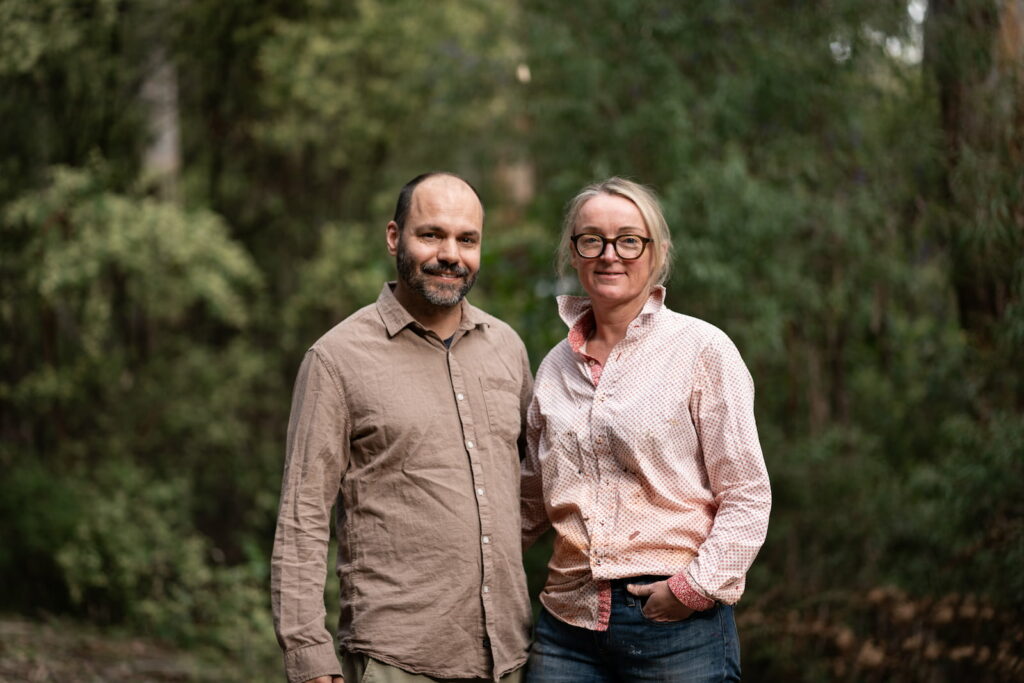
Most people in the Great Southern have heard of the Gondwana Link in one way or another. Maybe you have driven past a property undergoing restoration, attended a planting day, or heard someone speak about the vast vision behind it. For us, a visual artist and a sound artist living in Denmark, the Gondwana Link has become the backbone of a new collaborative project exploring how art has the capacity to bring attention to the quiet hope growing across these restored landscapes.
Gondwana Link is ambitious in a beautifully grounded way: restoring and reconnecting the diverse natural habitats that once stretched from Margaret River all the way to the Great Western Woodlands around Kalgoorlie and beyond. It is an ecological pathway of more than a thousand kilometres, threaded together by community groups, First Nations Elders, private landholders, ecologists, scientists, schools, volunteers and funders.
It is also a corridor of stories: of First Nations culture, of loss through widespread clearing, and of changing relationships with Country. As Goreng-Menang Elder Eugene Eades says, “Heal the Country and the Country will heal us.” This sentiment has guided our work from the beginning.
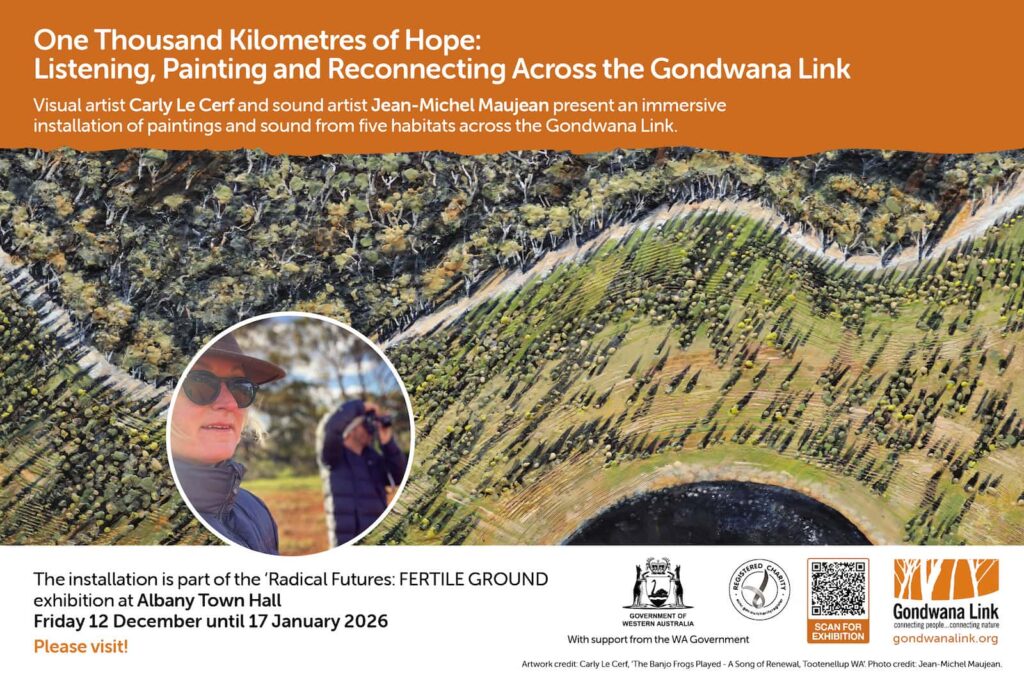
Our new body of work, ‘One Thousand Kilometres of Hope’ (originally coined by Gondwana Link’s Keith Bradby) will be a multi-sensory installation linking sound and image.
How the collaboration began
We are Carly, a visual artist creating large-scale encaustic paintings made from beeswax, pigment and damar resin, and Jean-Michel, a sound artist whose practice is centred around birdsong, field recording and immersive, multi-speaker composition. We live together in Denmark, and we relish any opportunity to get out and experience the rich biodiversity that is all around us.
Our collaboration developed very naturally. We would head out camping and hiking together, each absorbed in our own practice, with Carly painting plein-air studies and gathering colour samples, and Jean-Michel recording the landscape with multiple microphones and taking photographs. It didn’t take long for us to realise that we weren’t creating separate works at all. We were making two parts of the same story.
The idea grew from there.
First encounters with Gondwana Link
Jean-Michel first came into contact with Gondwana Link through Annette Carmichael’s community-engaged dance project The Stars Descend. The performance series travelled across the corridor, with five large-scale works presented in five locations from Margaret River to Kalgoorlie. Jean-Michel created 45 minutes of sound for the Kalgoorlie chapter, inspired by Annette’s vision of an “explosion of birdsong” arriving with the Emu at the end of its long journey across the Link.
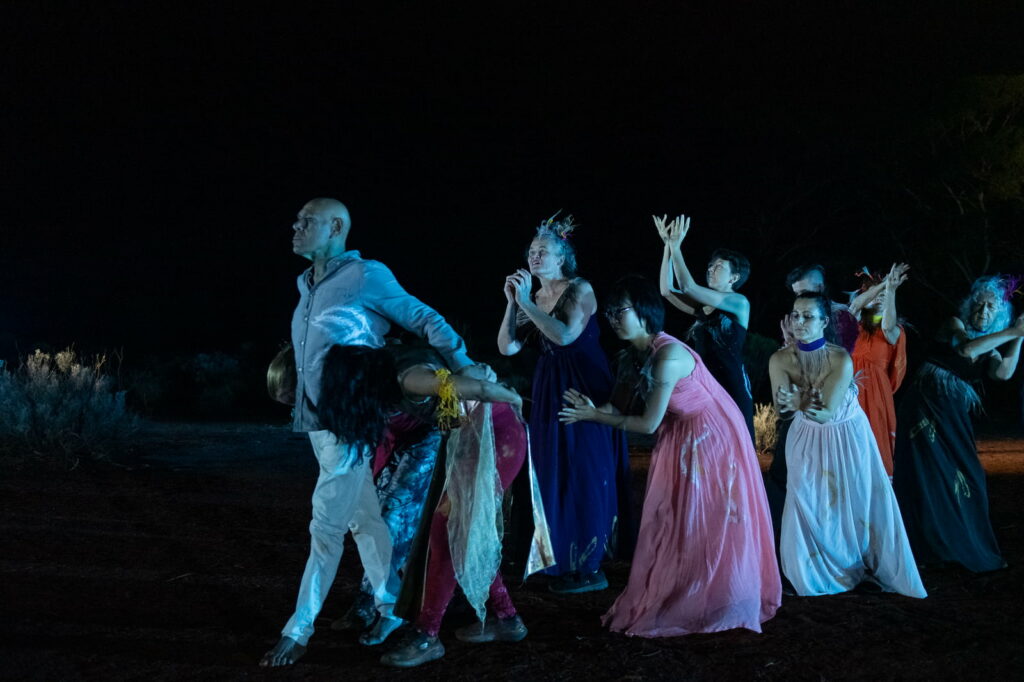
Seeing these landscapes, and witnessing how communities were restoring them, shifted something. At a time when environmental conversations can feel overwhelmingly bleak, here was a project grounded in action and collaboration. People were healing Country and you could hear it in the bird song.
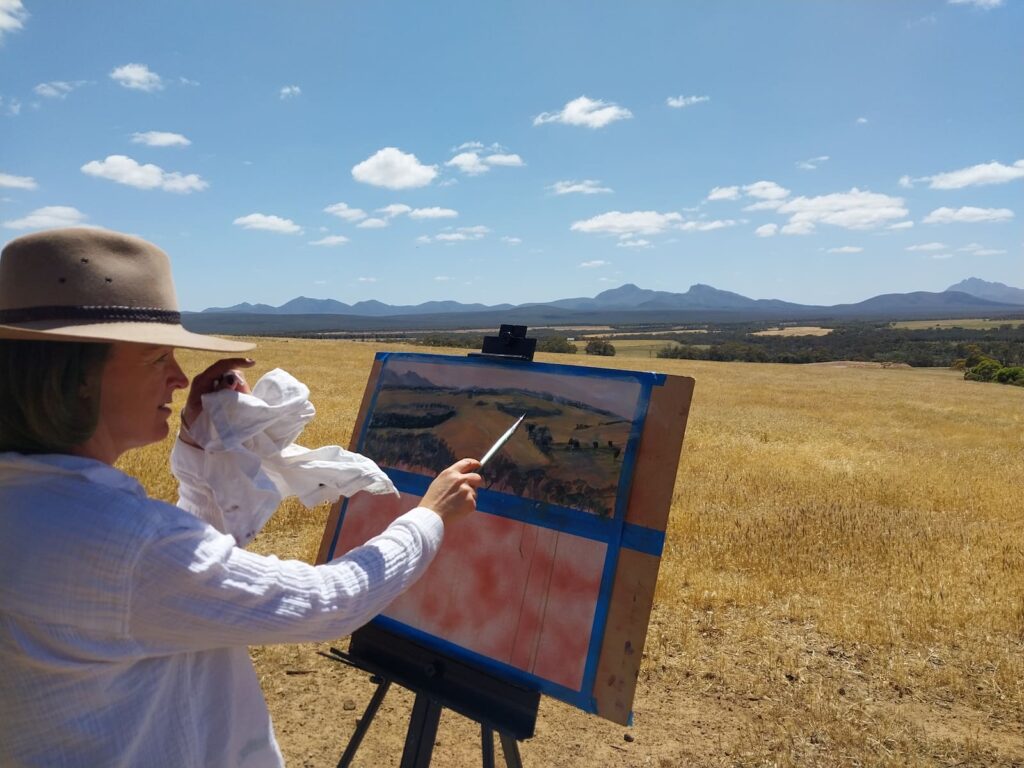
For Carly, the connection came through Green Skills and the Bella Kelly Eco-Art outings, and through years of painting local aerial landscapes that depicted the shaping of land by the human hand. Travelling through these areas, painting on location, she saw the traces of restoration in the colours, the density of new growth, the feeling of life returning.
The more we talked, the more we realised the synergies and that we wanted to make something together. Something that acknowledged the corridor, the people caring for it and the ecosystems slowly knitting themselves back into place.
Travelling across the ecological pathway
Guided by Keith Bradby, by Basil Schur of Green Skills, Peter Hill, Ruth Maddren of Nowanup Noongar Boodja and Uncle Eugene Eades, we selected five locations across the Gondwana Link and spent time in each. Some were sites of active restoration. Some were pockets of surviving bush. Others were transitional places, neither untouched nor fully healed, but alive in their own way.
At each site we camped, walked and allowed ourselves to be truly present. Carly gathered colour studies, aerial photographs and plein-air work that would later become the basis for her large-format encaustic paintings. Jean-Michel recorded dawn choruses, frog calls and the shifting textures of each environment using multi-microphone arrays. We took ground and aerial video. We talked a lot about what we were seeing, hearing and feeling.
These field trips shaped the heart of the project: ‘One Thousand Kilometres of Hope’ .
1. Pemberton – Delicate forests and layered dawn
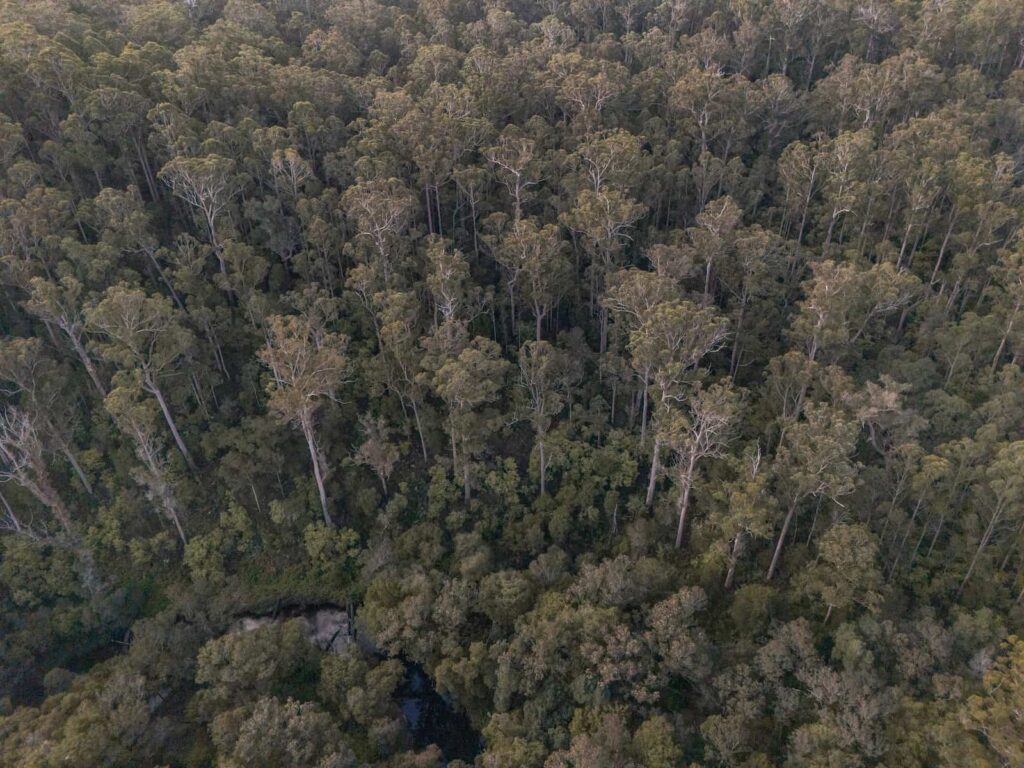
In Pemberton, the forest felt almost soft. The Karri canopy filtered the morning light into a pale gold, and the air was cool and layered with moisture. Carly created plein-air works that took in the abundance, drawing her palette from leaf litter, old tree skins, and shredded bark: reds, pinks, greens, warm yellows, and silver-mauve greys that sing together. She leaned fully into the gamut of colour and form.

Sonically, this was the most delicate of all five sites. The dawn chorus began with a thin, high shimmer of Honeyeaters and Grey Shrike-thrush before settling into the liquid, flute-like calls of the Golden Whistler (Western). It set the tone for the whole project: a reminder that restoration is as much about subtlety as spectacle.
We lifted the drone through a small gap in the canopy, hoping to capture a track, a sign of humanity within an abundant landscape. The trees were so densely interwoven that tracks were invisible. That, in itself, tells the story of this place. Instead, we captured the river weaving a gentle “river road”. That begins the first panel of the Gondwana Link series. It is a soft journey by foot or paddle, a place to return to again and again, a reminder of the richness possible through regeneration and protection.
2. Tootenellup – Frogs and firebreaks
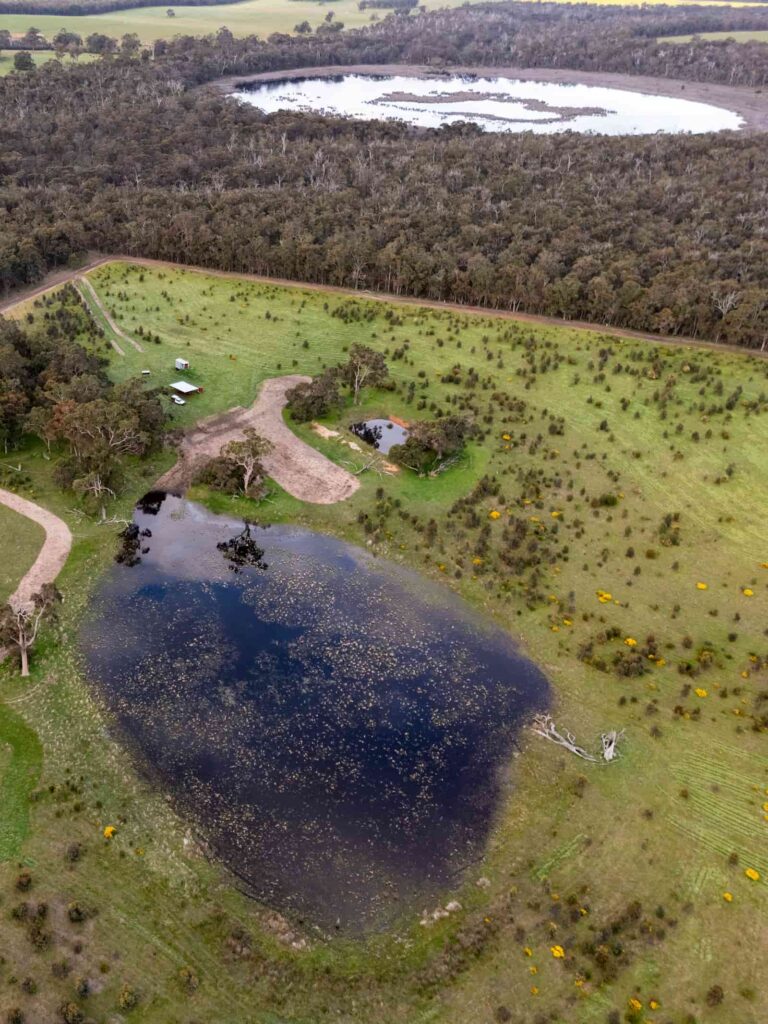
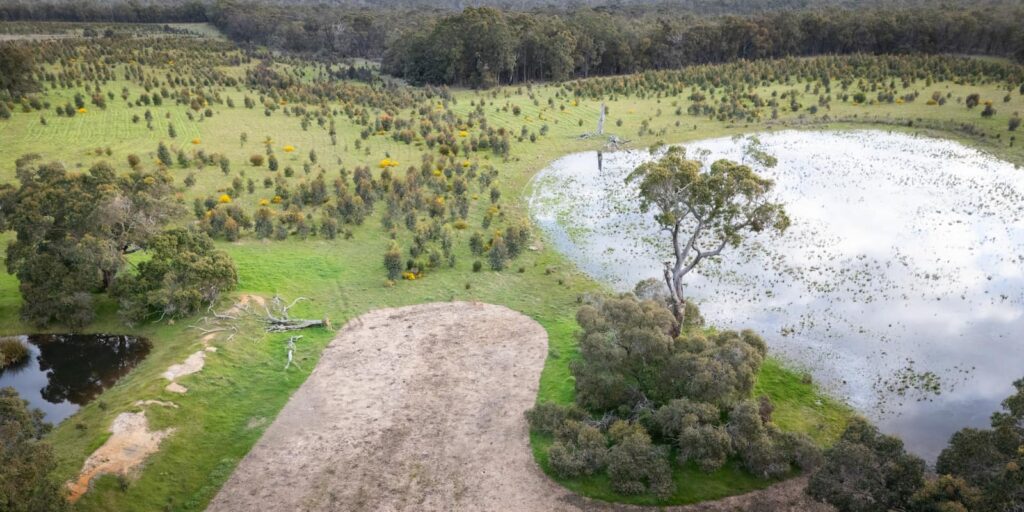
Tootenellup offered something entirely different. Here the cleared land is undergoing rejuvenation with the areas of restoration plantings and native bushland separated by tracks and fire breaks. Carly responded to these shapes and the reflections of gnarled jarrah trees mirrored in the wetlands. Her works explored the paddock grasslands speckled with yellow Acacia blooms. Lines of young trees taking root and blending into the natural bushland beyond.
At dusk and dawn, frogs dominated the soundscape. A pulsing, spatial “bonging” that echoed across the wet ground. This became the backbone of the site’s field recording. It was also the first time we noticed how sound reveals the health of a place: frogs only fill the air like that when water cycles are working.
Our aerial photography was inspiring as it clearly depicted the amazing work completed by Green Skills and how much of the property was flourishing.
3. Nowanup – Quiet presence and Butcherbird solos
We travelled to Nowanup, deep in the heart of the Gondwana Link. It is a place we felt particularly grateful to spend time in, where cross-cultural regeneration includes extensive replanting of farm paddocks and the reintroduction of Noongar cultural burning practices guided by traditional knowledge. Nowanup holds a distinct and powerful energy. It is cared for with deep cultural, spiritual and ecological intention, shaped by the leadership of Noongar Elders and many years of community-driven restoration.
Carly was immediately drawn to the breakaways, those crumbly ochre-coloured outcrops shifting from deep red to yellow and white, each layer revealing the passage of ancient time. Her site-based paintings explored the fascinating dialogue between organic and geometric forms, between the spontaneous shapes of nature and the deliberate marks of human care. On location, Carly used some of the found natural ochre to colour her studies. From above, the Six Seasons geoglyph, created by Uncle Eugene Eades and Justin Jonson of Threshold Environmental, was mesmerising, particularly in the early morning and late afternoon when long shadows swept across the land, giving the planted forms drama and depth.
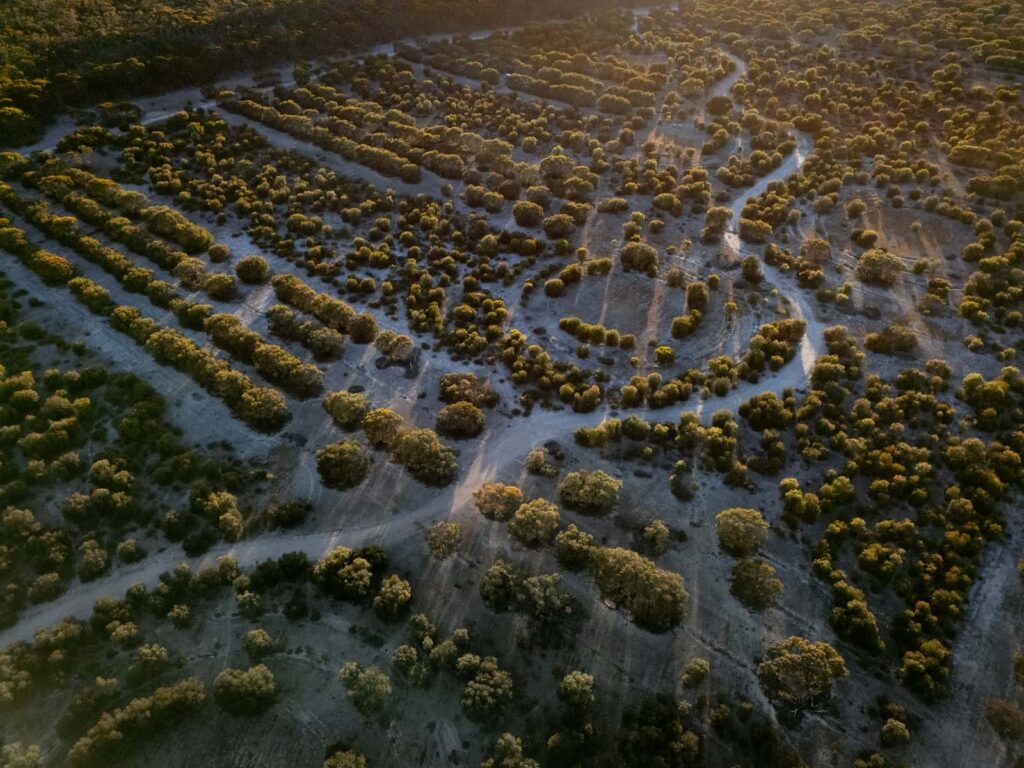
Listening from within the geoglyph was particularly rich in birdsong. The replanted country is now providing a strong habitat, and the soundscape reflects that. Golden Whistlers (Western) called from nearby, while a Grey Shrike-thrush projected from further afield. A Crested Bellbird provided a steady rhythmic pulse beneath the wider chorus, giving the whole place a distinct acoustic character.
We left Nowanup inspired to return to the studio and create works that celebrate this place and the extraordinary geoglyph that stands as a symbol of healing and hope.
4. Site 13 (unnamed) – After fire still standing
One of our most affecting locations was an unnamed patch known to us only as “Site 13”. We travelled through hundreds of thousands of hectares of scorched bushland in the Great Western Woodlands before finding this oasis of old growth Salmon Gums. We had two chilly nights at minus one degree; the days were perfectly still and we had the place to ourselves.

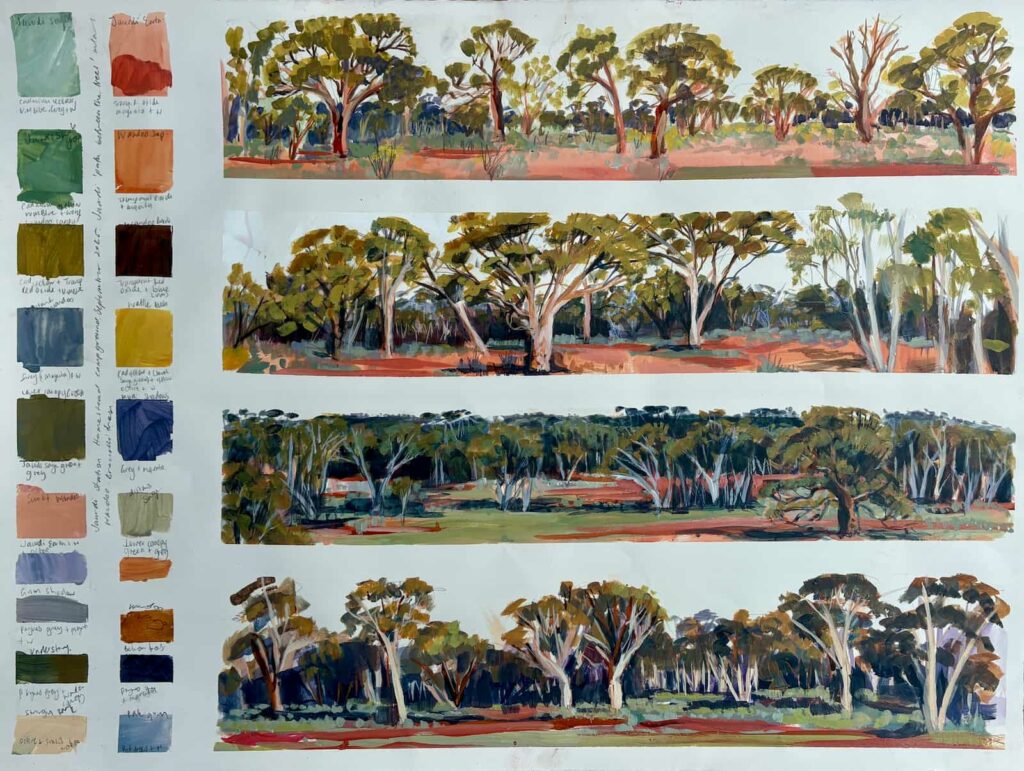
Carly was pleased to find the pink, sinewy Salmon Gums she had been longing for, their curved trunks and umbrella canopies glowing orange at the crown. A misty morning with sunlight at her back made painting those glowing trunks pure joy. Rotating her easel through Country, she painted amid a mosaic of burnt, regenerating, and old growth trees. She also ground found charcoal into her studies, and spent time replicating the soft blue greys, pinks, and rusty oranges of the site.
The field recording from this site is the most moving in the entire set. A solo Pied Butcherbird sang for almost an hour, as if performing an intimate solo composition for the land around it. The site demanded a stripped-back musical response: a frame drum pulse that feels like breath or heartbeat rather than rhythm.
5. Jaurdi – A chorus of declared hope
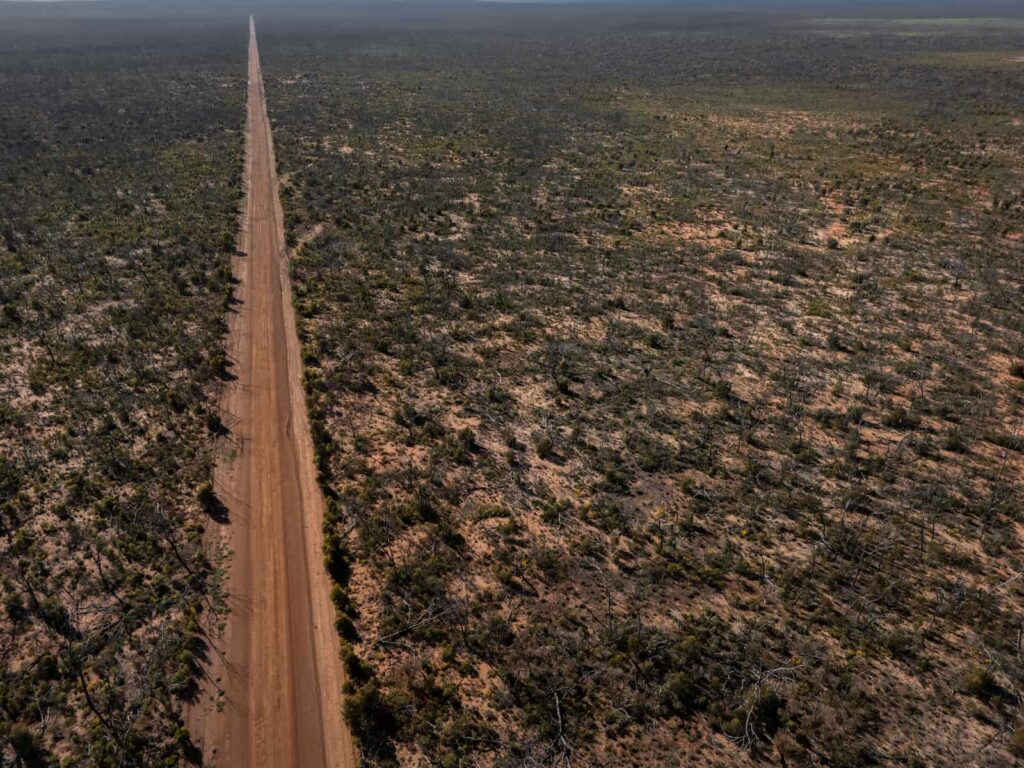
Jaurdi, north-east of Southern Cross, near the northern end of the Gondwana Link, felt like a true point of arrival. The vegetation shifts noticeably here, with open woodland, sweeping plains and a vastness that is hard to put into words. Travelling along muddy red tracks to the upper reaches of the Gondwana Link, we were met with clearing skies and two spectacular days of solitude and red earth. Absolute soul food. With the expedition now fully in motion, we found ourselves in the most remote of the five major Gondwana Link sites.
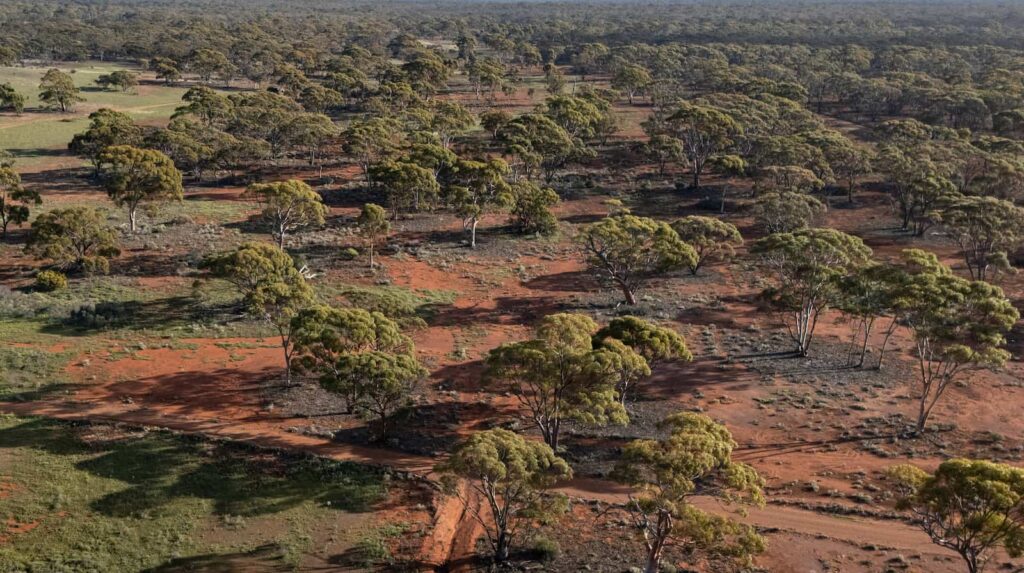
Carly’s colour palette changed dramatically towards the hues of the outback she is most comfortable with. Rich ochres, iron-rich reds and the soft greys of the woodland canopy. Her plein-air works took in the shiny Gimlet and Wheatbelt Wandoo trees and the peachy-red earth dotted with an understorey of soft grey-green saltbush.
Sonically, it was the most energetic recording. Multiple butcherbirds and honeyeaters formed a lively chorus that moved around the microphones like a conversation carried on the wind. Standing there, you could feel the scale of the Gondwana Link, both physically and symbolically.
The visual artwork: Five panels and a ribbon of hope
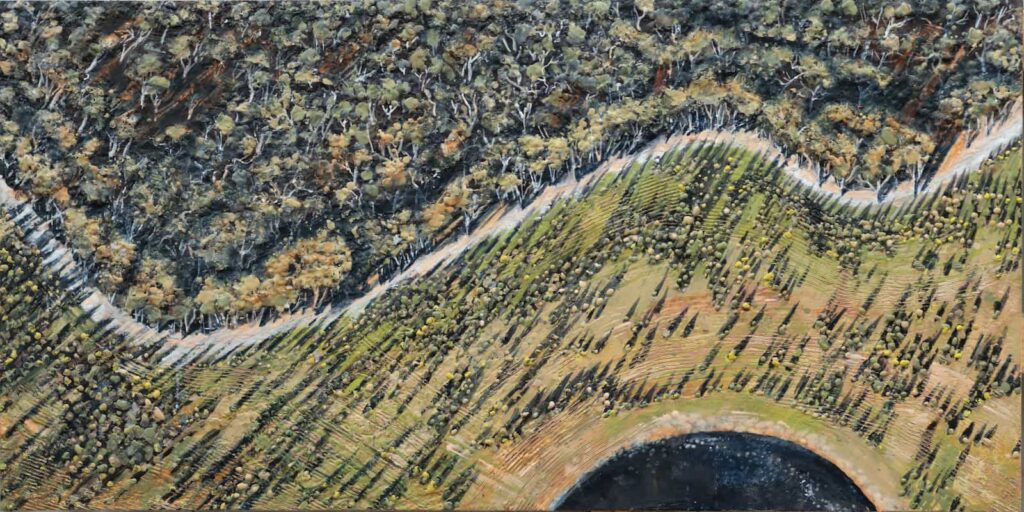
The final artwork brings together five encaustic paintings arranged in a connected formation, each representing one of the five locations along the Gondwana Link. Painted using Carly’s rich, layered beeswax technique, the panels are highly textured yet remain strongly representational, capturing the essence of each landscape. A single continuous track runs across all five panels, linking otherwise separate sites and symbolising human presence, movement, and our shared responsibility.

In the installation, the paintings, which vary in size, are hung at different heights, visually mapping the shape of the Gondwana Link ecological pathway as seen via satellite imagery. The connecting firebreaks, tracks, and rivers thread the works together. Each panel is unique, yet they belong together, mirroring the corridor itself: five distinct ecological moments that come together to form a larger, interconnected story.
The visual installation invites viewers to witness the diversity of the landscapes and reflect on how best to manage and care for these places.
The sound: A corridor you can hear
The sound installation mirrors the structure of the paintings. Each location has its own multi-microphone recording, played through a five-speaker acoustic tunnel that surrounds visitors. Rather than listening to a single stereo track, audiences can step inside an environment made from field recordings. The birds take up positions around you, distance and direction shift, and the land becomes something you inhabit, not simply watch.
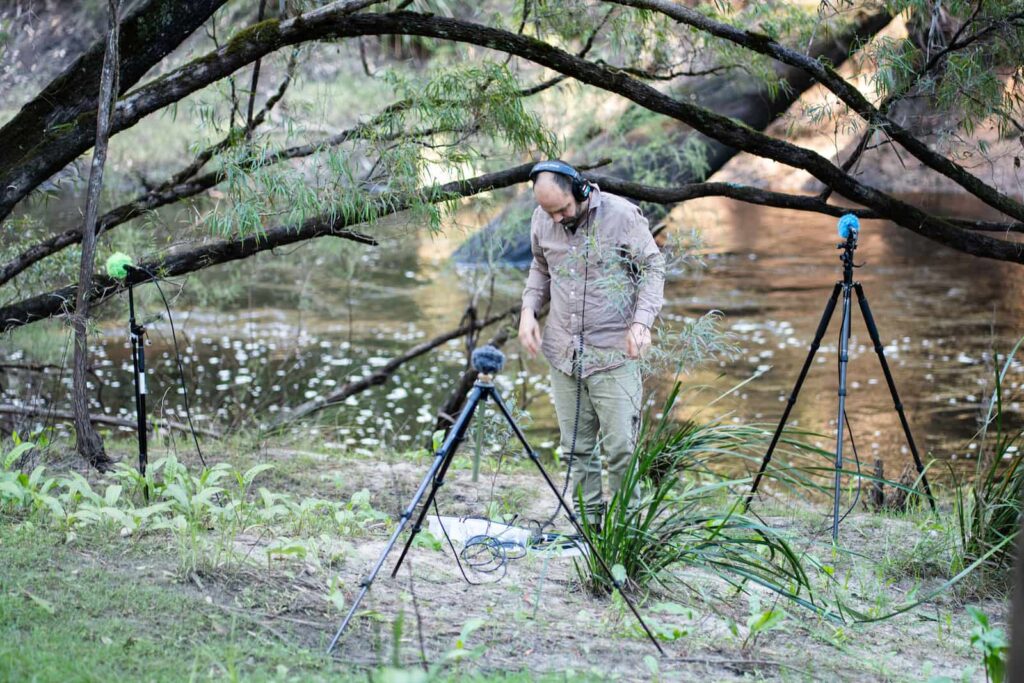
For this project, Jean-Michel composed a musical motif for each site: piano, percussion, strings, bass and xylophone. Each instrument interacts with its corresponding field recording, sometimes supporting it, sometimes contrasting it. When combined, they form one complete musical piece, just as the five visual panels form one complete image.
These motifs act like footprints. Small human gestures tracing their way through the soundscapes.
Art can inspire change
In recent years, many of us have felt the weight of climate despair, a sense that the damage is too great and the solutions too slow. But working across the Gondwana Link has revealed a different story, one grounded in action, care, and persistence. People are donating for land purchase, revegetating cleared paddocks, monitoring the return of wildlife, walking Country with Elders, and caring for regenerating bush year after year. Many of the landscapes along the Gondwana Link still need substantial support to thrive and return to the ecosystems they once were, but these acts, large and small, demonstrate that change is possible.
This project is a response to that story. It does not ignore the challenges, but it leans toward hope, the kind of hope you can see growing in a paddock where habitats planted fifteen years ago are now alive with songbirds and frogs. We believe art can hold space for renewal. A painting can show shifts in the land that are hard to put into words. A field recording can reveal the health and vibrancy of an ecosystem to audiences. A soundscape can make you feel present in a place you have never visited.
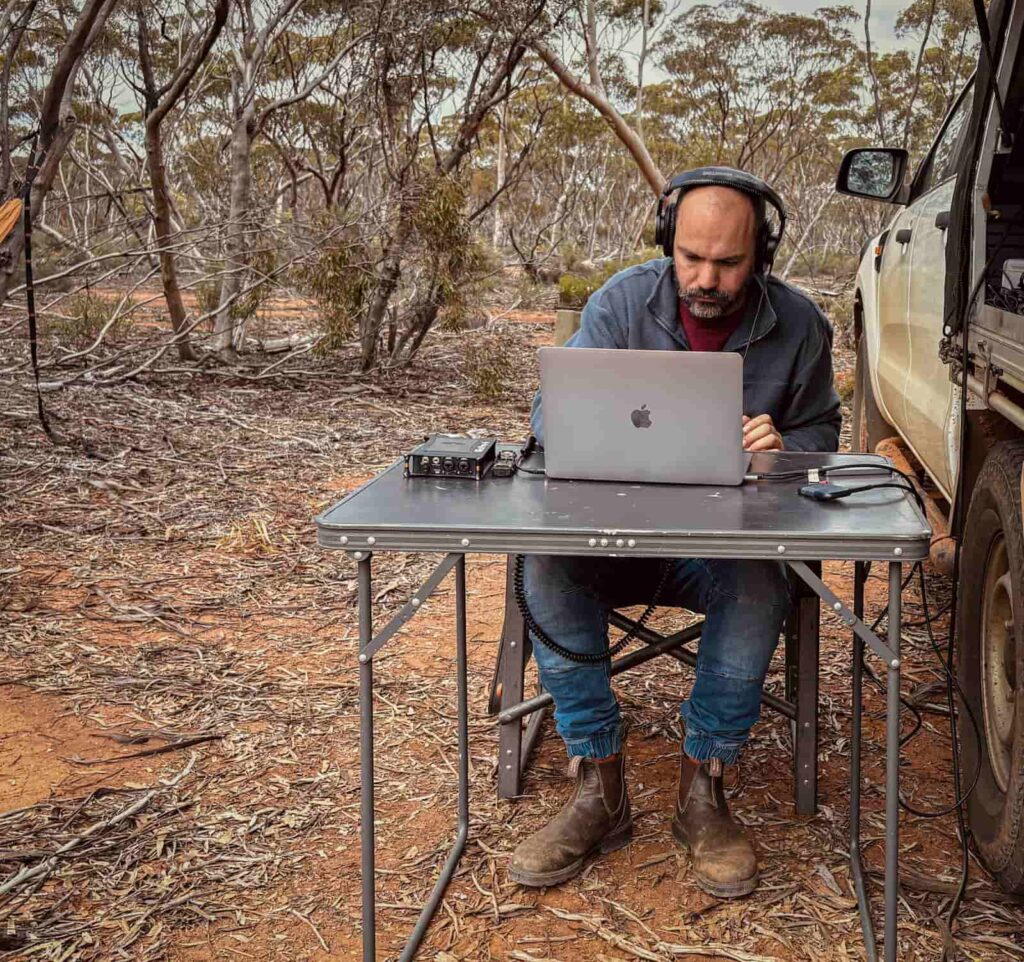
Through this collaboration we hope audiences slow down, listen, look closely and reconnect with the landscapes that surround us. We hope this artwork reaches people who may not read scientific articles, and that the visual and sonic elements might touch new audiences in unexpected ways. Everyone takes things in differently, and it is our hope that even a few people may leave inspired to act and support the Gondwana Link project, understanding that every small effort contributes to the resilience and recovery of these landscapes.
Where next?
‘One Thousand Kilometres of Hope’marks the beginning of a much larger journey for us. We plan to continue travelling across the Gondwana Link, building a long-term archive of sound, images, and stories that document the evolving health of the land. Looking ahead, we imagine future exhibitions, installations, performances, sound walks, community workshops, and collaborations with restoration groups, artists, writers, poets, and filmmakers.
We are excited to expand the reach of this work by sharing it in regional galleries and art centres across Australia, and to explore how cross-disciplinary collaborations can deepen audiences’ connection to place. While landscape painting and field recording remain central to our practice, we aim to bridge conceptual and accessible art, creating works that inspire hope and foster a sense of responsibility for these remarkable landscapes.
For now, this project stands as our way of celebrating the thousands of hours of quiet work happening across the region, and the landscapes that continue to recover because of it. The Gondwana Link is a long, slow story, but it is also a hopeful one, and we feel privileged to be listening, painting, and walking a small part of it.
THANKS to Carly Le Cerf and Jean-Michel Maujean. Thanks also to Basil Schur, Carol Duncan, and Alison Goundrey and her birdo friends. Editing by Margaret Robertson and Keith Bradby.
‘One Thousand Kilometres of Hope’ is produced with support from the WA government.
Further information
Carly and Jean-Michel’s ‘One Thousand Kilometres of Hope’ installation will feature in the Radical Futures: FERTILE GROUND exhibition at Albany Town Hall, Friday 12 December 2025 to 17 January 2026. Exhibition information is available here.
View these media stories for insight into Jean-Michel’s PhD studies as a sound artist: How West Australian songbirds are composing new music | SBS NITV; ABC News 2021
See some of Carly’s fabulous recent works here: Wayfinding: A Painter’s Path exhibition 2025
For short video stories about the 1000 kilometres of the Gondwana Link project, visit our Vimeo or YouTube channel.
Watch our much-loved 48 minute film ‘Breathing Life into Boodja, set in the central Gondwana Link. Visit our film distributor Ronin Films website for Vimeo On Demand (a small rental fee for a 48 hour streaming period): here.
Jean-Michel refers to his part in the vast dance work The Stars Descend. The production is captured in a film titled Creative Actions for Climate Hope – The Stars Descend. Made by Josephine Jay for Annette Carmichael Projects, the documentary tracks the making of The Stars Descend. This five chaptered story was created with communities and artists along the 1000 km ecological pathway of the Gondwana Link, stretching from Wooditjup Margaret River to Garlgula Kalgoorlie. The work celebrates the collective efforts of land care groups to protect and restore habitat that forms the Gondwana Link. This uplifting film is available on YouTube.