Porongurup science and cultural knowledge combines

DR LYNETTE KNAPP and PROFESSOR STEPHEN HOPPER AC have been collaborating on biodiversity conservation research for fourteen years. Today, they are sitting at the base of the Porongurup Range (Borongurup) ‘yarning up’ this special place with their colleague and former student Dr Ursula Rodrigues. They discuss how the Range’s great age underpins its cultural and biological significance, and how combining science and Noongar knowledge can help us care for the extraordinary landscapes of southwestern Australia.  

September 2026

Lynette and Steve’s collaboration has been built through many shared yarns on Country, usually over a cup of tea. The smells, sights and sounds evoke memories and conversations that have led to new insights for conservation. Image: Ursula Rodrigues.

Ursula: We’re sitting on Millinup Road on the southern edge of the Porongurup Range, gazing up at Castle Rock. It looks so dramatic cloaked in the morning’s light mist. Aunty Lynette, can you tell us about this place?

Lynette: Well, I’m a Merningar Yorga, a woman of the south coast shell, white sand or whale people. I belong to the coastline from Denmark in the west to the beginning of the Bight, and from the sea and the islands in the south to the northern end of the talyeraak (Eucalyptus pleurocarpa) boundary. I can only talk about my family’s stories.

Lynette and her boundary-marker tree, talyeraak (Eucalyptus pleurocarpa), photographed in 2017. Image: Steve Hopper.

I’ve known about Borongurup all my life. Borongurup is something that you remember when it’s told to you. It’s so big, you never forget it.

We used to camp around the eastern end of Borongurup, at the bottom of it. Dad had a friend there, Uncle George Dunn. We would camp right next to his farm, at a place where the beautiful brown boronia grows in the swamps.

Lynette’s father Alf Knapp, from whom she learned much of her knowledge about Country. Image: courtesy of Lynette Knapp.

My family has lived on our Country for 75,000 years, plus. We learned what to forage for. We learned the mountains, the plains, and the creeks, and the most prominent, sacred place on our Country is Borongurup. We hold it in high esteem. It’s got some of the oldest rocks in the world. It’s an amazing place.

Castle Rock is connected to a creation story for our Knapp family. The creation starts in Albany and Castle Rock is where one of our creator spirits now rests.

There’s no ownership on Borongurup because it belongs to our land, it belongs to our stories. It’s our connection with the Earth.

Lynette and Steve being interviewed by Ursula at Warrumbup (Weedon Hill), Denmark, during Ursula’s Honours research in 2020. Image: Alison Lullfitz.

Ursula: Steve, how did the Porongurup come into your life?

Steve: In 1977, I started as the state’s first Flora Conservation Officer with Fisheries and Wildlife. My job was to devise ways of caring for flora across the state. In 1979, a list of presumed rare species was published from herbarium records by botanists Neville Marchant of the WA Herbarium and Greg Keighery of Kings Park. We soon found that rarity in the herbarium didn’t equate to rarity in the wild. So, we had to get out in the bush.

Aerial photograph looking south-east towards the Porongurup Range, taken during Steve’s fieldwork in 1979. Image: Steve Hopper.

Greg had been living in Albany and knew of rare plants in the Porongurup. In the early 1980s, in my early thirties, we spent a few days climbing the Porongurup to see those plants. One of them was a thing that looks really exotic and grows in shallow soil adjacent to the granite. It has since been looked at in detail, and it turns out that it is actually two species that occur only here. I returned over the years, and we continued to discover species that are both endemic, occurring nowhere else, and rare.

I came as a tourist, too. In 1980, my parents came over for the last time to WA, and we stayed at Karribank. I’ve got photos of Dad standing beside Angwin Peak and Tree in the Rock.

It wasn’t until 2012, when I came to take up my current position as Professor of Biodiversity at UWA Albany, that the Porongurup Range became part of the daily routine; a core part of living in Albany. My wife Christine and I see them from our house at Goode Beach. Since then, I’ve been here on several trips with Lynette and other Elders. This has changed my views of Borongurup immensely. I think it’s just remarkable to hear stories of this place that go back generation upon generation from Lynette and her family.

Ursula: Would you be able to share some of those stories with us today, Lynette?

Lynette: My father used to call it Bor-ron-gor-up. Borongur is our word for totem. We each have a plant and an animal totem. Borongurup refers to place of totemic spirits.

In our culture, we believe there’s two sides to each of us: soul and spirit. When someone passes away, our soul goes to the land that you see between the sea and the sky, and our spirit goes back into our borongur (totem animal and plant) to replenish them for future generations. When our borongur die, they become totemic spirits and they go back into the rocks on this beautiful range.

Borongurup is our sacredness. This is older and just as sacred as Uluru.

Borongurup also links up with Warrumbup (Weedon Hill), that sacred hill in Denmark. One of my family stories goes with Warrumbup being the birthplace of all rocks on our Country. At Warrumbup, there’s a tree that looks like it’s giving birth to a granite rock. We believe the rocks rolled away from there forming these kaats (hills) here at Borongurup. We call them kaats, like we call our heads kaats. They’ve got eyes and ears, and they watch us and make sure that we respect our Country. Rocks aren’t nothing; they are very much alive.

Ursula closely inspects the formation of a karri tree and granite rock at Warrumbup, where the Knapp family believe the tree gave birth to the rocks. Image: Alison Lullfitz.

Ursula: I remember you showed me Warrumbup during my Honours research. Steve, how does this relate to what science tell us about how Borongurup was created?

The Porongurup Range has been a true island numerous times in its life, most recently about 55 million years ago. The diverse habitats created by the geologic formation also act as biological islands, providing refuge for species with specific habitat needs and allowing persistence of species with Gondwanan associations. Today, the surrounding agricultural landscape means the National Park acts as a habitat island for many organisms. Image: Martin Regtien/AirPix & GreenSkills.

Steve: The Porongurup Range is characterised by granite and gneiss outcrops and boulders. The granite itself is a product of the west Australian Yilgarn craton and Antarctica crashing together to form the ancient continent Gondwana about 1.2 to 1.3 billion years ago; the Earth is about 4 billion years old. Borongurup is the stub now of a mountain range of incredible antiquity.

Lynette has just explained that this is the place where, for Noongars, it all began — where the rocks from Warrumbup rolled to create the place of totemic spirits. It’s an example, I think, of Noongar insight that is streets ahead of Western science. The whole notion of shifting continents only became widely accepted by science in the 1960s. Whereas, Noongars have known about this place forever, essentially. I think that’s just fantastic.

Unlike much of the northern hemisphere, southwestern Australia has not been glaciated for hundreds of millions of years, since prior to its separation from Gondwana. Instead, these ancient granites have weathered very slowly into the domes we see today. This has allowed for continuous speciation and resulted in the rich biodiversity that now inhabits the Range and the region. Image: Ursula Rodrigues.

Ursula: It seems to me that there are many examples of congruence across Noongar and scientific knowledge.

Steve: There are. The slopes that we’re looking at now on the south side of Borongurup are patches of granite amongst karri trees. From a scientific perspective, this population of karri has been distinct from others since the end of the last glacial maximum, around 5000 years ago. In the story about the trees giving birth to granite over at Warrumbup in Denmark, that’s a karri tree, too. So not only did the rocks get dispersed across the landscape, but the karri comes with them.

But if I look down from the slopes and karris to the trees growing on farmland to my right, we could be anywhere in the world. There’s Tassie blue gums and Monterey cypress from California and there’s east coast wattles flowering. This reflects a history of some people believing that the native trees here weren’t worth growing once the land was cleared.

Lynette: Our native trees are important to us. In our way of looking at different trees, the people of the jarrah (Eucalyptus marginata) from the west could come and have as much knowledge and inclusion at Borongurup as the people from the talyeraak (Eucalyptus pleurocarpa) to the east because both those trees grow near Borongurup.

Ursula: Steve, what other patterns can be seen in where the plants grow?

Steve: While surveying for rare plants in the 1970s and ‘80s, across south-western Australia, botanists discovered that two-thirds of the genuinely rare and threatened plants were confined to the upper parts of the landscape. Borongurup is a classic example of this. Of some 700 plant species found here, nine or ten species are endemic, and the majority of them are found only on the upper slopes.

Lepidosperma hopperi, a granite endemic sedge, growing in the Porongurup Range. This species is named in recognition of Steve’s contribution to understanding the flora, particularly of granite outcrops, in Western Australia. Image: Steve Hopper.

We now know it’s not only plants that are specialised to these peaks: it’s animals that don’t move around much, too. Spiders, land snails, earthworms, myriapods — all of them have locally endemic species to the Porongurup, and many are confined to the upper slopes and hilltops.

This short-range endemic trapdoor spider with Gondwanan heritage is known only from on and around the Range and is one of many endemic invertebrate species found there. Image: Loxley Fedec.

Ursula: I think it is one of the richest mountainous areas for spiders in Australia. What are some of the conservation challenges for such an important place?

Steve: Well, right now, we’re sitting at the foot of the Porongurup with the houses and farmland. And Lynette has taught me that in her culture, people would camp, hunt and burn country down here.

Lynette: Yes, right where we are. My family wouldn’t climb these peaks because it’s sacred.

Shadows reveal the meely (eyes) in the kaat (head) of Gibraltar Rock on the Porongurup Range. The eyes watch over Country, ensuring that people act with appropriate respect. Picture: Steve Hopper.

Steve: Yet, it’s the peaks and the bare granite that walking and mountain bike trails often aim for. But no one has worked out how to get the tiny and rare plants back onto the granites after bikes have eroded away the soil. It would be distressing to see more trails on these peaks.

Lynette: There’s no explanation to the damage from bikes — they shouldn’t be on our kaats. It is fair enough to use already cleared areas down here for trails, but I’d hate to see the damage get any worse. And any plans for making more infrastructure like the Castle Rock Skywalk – that’s a big no-no. Leave the tourist spots as they are, but don’t do anymore drilling into rocks. I’d like to see people learn the importance of Borongurup. As totemic people, we’re here to look after the Country.

Lichens and mosses, which cover the rocks, grow slowly and will take a long time to recover from the damage caused by wheeled vehicles. Image: Steve Hopper.

Ursula: Aunty Lyn, I’ve heard you talk about this as an obligation to care for Country.

Lynette: For Noongar people, our life is an obligation: we’re obligated to look after each and every one of us and that includes Country. If you belong to this Country, your DNA is in all these things: rocks, plants, dirt. It’s not, “Well, that’s a tree”; that’s part of your family.

Ursula: How can we all better incorporate this ethic into our care for landscapes?

Lynette: I like what’s happening now by groups that are buying farms and replanting, like over here at Twin Creeks, because we need our bush back. And we need to start sharing a bit more with people like that.

Steve: We do. We need to work with Noongar Elders and groups like the Friends of the Porongurup Range, who look after Twin Creeks Conservation Reserve, to find common ground to care for Country. Off the top of my head, I can think of at least half a dozen principles from Noongar practices. Respect for things old is the classic case. I’ve learned it’s not just elder people, it is old landscapes, like the Porongurup, and old trees.

Another is the use of eucalypts to demarcate boundaries among dialect groups, like Lynette’s boundary marker — talyeraak. We live in the richest place on earth for eucalypts. Wouldn’t it be fantastic if every West Australian said, “I’ll adopt a eucalypt”. With about a quarter of the genus currently threatened, eucalypts would be in much better shape if we did. You don’t have to be a botanist, either. Everyone can recognise a karri tree.

I’m quietly optimistic we’ve got a future if we can combine these two wonderful knowledge systems going forward.

Lynette: Definitely. And it helps when you’re good cobbers.

Steve: My modus operandi in the bush is to go exploring; I can’t drive past a track I haven’t been down before. I learned that Lynette is the same. She would often sing out, “why don’t we go down there and have a look?”. I’d think, “Fantastic, let’s do it”.  We often find something new.

Ursula: Aunty Lynette, how do you reflect on your collaboration with scientists?

Lynette: It’s been wonderful working in tandem with Steve. It’s a beautiful thing to watch Western science and Noongar science coming together.

Steve: There’s still a lot for me to learn. Every conversation, there’s something new. Part of it is learning to be humble and genuinely listen, and not to impose scientific views on everything. Soak it up and repeat the exercise often.

Lynette: I think the Western science will catch up soon.

Steve: Well, on some things, hopefully. My discipline, biodiversity conservation, hasn’t done a crash-hot job in caring for Country. But I really am convinced now, after 14 years of working together with Lynette and other Elders, that there are principles adopted by Noongar people that, if embedded in Western culture, we’d be doing a much better job.

Trachymene grandis grows in a moss mat adjacent to the granite slopes. It is one of many annual herbs that abound in this diverse habitat during winter and spring. Image: Steve Hopper.

Ursula: This year, the Porongurup National Park is 100 years old. Do you have a vision for caring for it for the next 100 years?

Lynette: The granite here that holds our totemic spirits must be recognised and I think we should have a say in its management. We need people to start looking at our Country through our eyes. It’s amazing to realise, when you sit here and look at those magnificent trees and plants and animals: they’re living creatures. We need all those things to be able to live. So, we should help them live.

Steve: I think Lynette summarized it beautifully. It comes down to what is it to be genuinely Australian. That’s something I don’t think we’ve quite mastered as a broader, multicultural community. Yet, we have this great gift of Aboriginal communities who’ve lived over incredible periods of time across the nation, whose lives are framed around respectfully living in a local place, understanding what Country and their ancestors tell them, and revering and celebrating that. I think if the broader community can understand this ethic, places like Borongurup will be even more important than most people appreciate now.

THANKS to Lynette Knapp, Stephen Hopper, Ursula Rodrigues and the photographers. Thanks also to Margaret Robertson, Loxley Fedec and the Friends of the Porongurup Range. The Southerly Magazine kindly published this story in its September 2026 edition (pp. 18-23). In this centenary year of the Porongurup National Park, we acknowledge the park’s management by the Department of Biodiversity, Conservation and Attractions.

Further information

Friends of the Porongurup Range: The Friends are a not-for-profit community group dedicated to conservation and protection of the Porongurup region and the National Park. The following link to their website will connect you with events that are taking place in 2026 to commemorate the centenary of the Porongurup National Park, including the Centenary Exhibition at the Porongurup Hall, 14-29 November 2026. More details here: https://www.porongurup.org.au/centenary

The Porongurup National Park is on the National Heritage List: Here’s an outline of the values underpinning its listing: https://www.dcceew.gov.au/sites/default/files/documents/porongurup.pdf

Ranges Link video: This uplifting story of landholder-led conservation and restoration comes from the farming country between the Porongurup and Stirling Ranges. Farmer and native seed pioneer Peter Luscombe has teamed up with his neighbours the Friends of the Porongurup Range, working from their Twin Creeks Conservation Reserve, to build a major habitat link between the ranges. (Koi Kyeunu-ruff is the Noongar name for the Stirling Range). Produced by Gondwana Link Ltd for the Wild Life Gallery at WA Museum Boola Bardip: Ranges Link: Bringing country back to life | Heartland Journeys Duration: 2:36 min.

Twin Creeks Reserve: Community drive conservation‘: Meet some of the members of the Friends of Porongurup Range, an incredibly passionate and dedicated community group who own and manage Twin Creeks Conservation Reserve. This is a property of 511 hectares nestled between the highly biodiverse Porongurup Range and Stirling Range National Parks. Duration: 11:06 minutes.

Ranges Link: caring for the Kalgan River area‘: A Heartland Journeys podcast featuring some of the people behind the Ranges Link initiative, including Tim Saggers, Heather Adams and Peter Luscombe. Duration: 14.50 min.

In November 2022, we ran this heart-warming story featuring Sayah Drummond, a dedicated Porongurup local: Sayah Drummond: a refreshing perspective on making a difference | Heartland Journeys

Please visit the Centenary Exhibition at the Porongurup Hall, 14 to 29 November 2026. Here is your invitation:

Lynette and Ursula during fieldwork at an important site for the Knapp family north of the Porongurup Range. Lynette and Steve supervised Ursula’s five years of student research at UWA Albany. Through teaching and supervision, Lynette and Steve share their cross-cultural method and collaborative spirit with the next generation of people working to care for Country. Image: Steve Hopper.
Gnamma boorna, living cultural heritage, in a marri tree in Porongurup National Park. Through inter-generational horticultural practice, a water-holding hollow has been created at the base of the tree for medicinal and ceremonial purposes. Image: Ursula Rodrigues.
A lizard trap, or kaarda mia, is engineered habitat for reptiles found on granite outcrops in the Porongurup Range and across Noongar Country. Significant cultural artefacts like these can be difficult to spot, underlining the importance of not disturbing granite areas. Image: Steve Hopper.

Yarning about fire

Noongar Elders Aden Eades and Elizabeth Woods, and PhD student Ursula Rodrigues, are part of a team working on a cultural burning collaboration on Country between the Fitzgerald River and the Stirling Range (Koi Kyeunu-ruff) national parks.

As part of this project, they have been yarning about fire, its impacts on Country and its role in culture, as well as conducting Elder-led burns to revitalise Goreng Noongar fire knowledge and stewardship. Their story is a joyful portrayal of Noongar and wadjella people working, laughing and learning together as they undertake an important fire management study.

Aboriginal people are warned that this story contains the names of deceased persons.
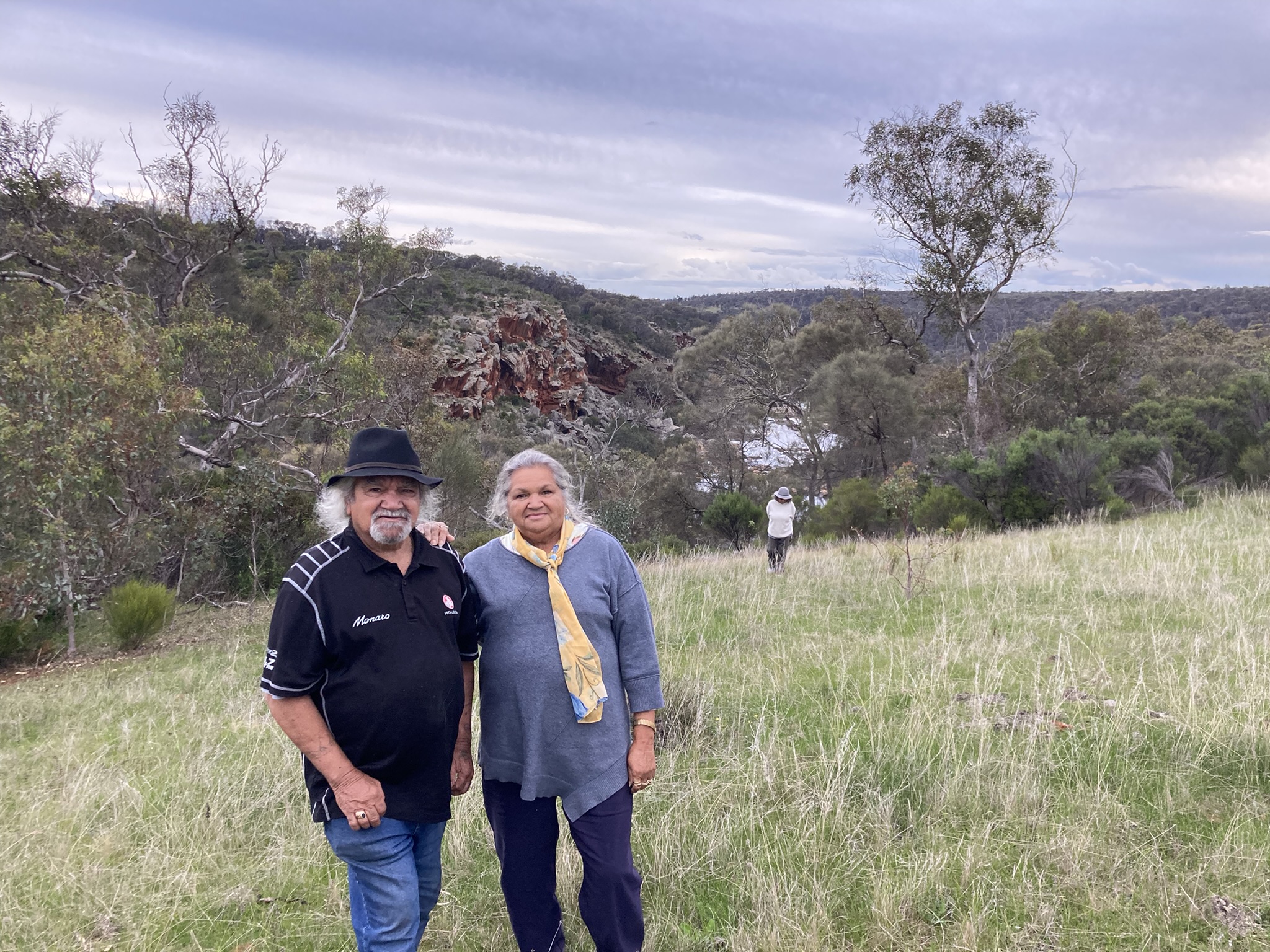
Aden and Eliza sharing time and stories during an on-Country trip to Boxwood Hill. Their cousin, Annette Woods, in the background. Image: Alison Lullfitz.

Siblings Uncle Aden and Aunty Elizabeth (Eliza) are yarning with Ursula from UWA Albany about the Eades-Penny family, their fire knowledge and the importance of fire in Noongar life.

Aden: Before we talk about fire, we have to acknowledge our old people and the Elders that taught us so much. On our dad’s side, Grandfather Eades was a good old teacher. His father was a wadjella (white person) and his mother was Lucy Coyne, an Albany Noongar. He picked up a lot of cultural knowledge from her and was a very knowledgeable bushman.

Grandfather Eades married our grandmother, Granny Ettie, who was an Arthur River Noongar. They had two daughters and ten sons — our dad was Fred — and they lived Noongar lives across the Great Southern and Southwest. Granny Ettie spoke language and knew all the culture and she handed that onto her kids. The boys all went into the bush; they were all good bushmen.

Eliza: Our mum’s dad is Grandfather Chris Penny. Through his mother, old Maggie Starlight-Piggot, he’s got connection to Denmark and further west, even though he was born in Kojonup. The family lived all over the Great Southern, finding work. They were one of the first families to go to the Jakitup school, out from Gnowangerup, where Pa Chris learnt to read and write. Pa was always a worker ‒ he was a shearer and builder; he helped build quite a few of the cottages on the United Aborigines Mission at Gnowangerup. Pa married our grandmother, Granny Agnes Woods, in Gnowangerup. They had thirteen children ‒ our mum, Ayplin, was their eldest daughter.
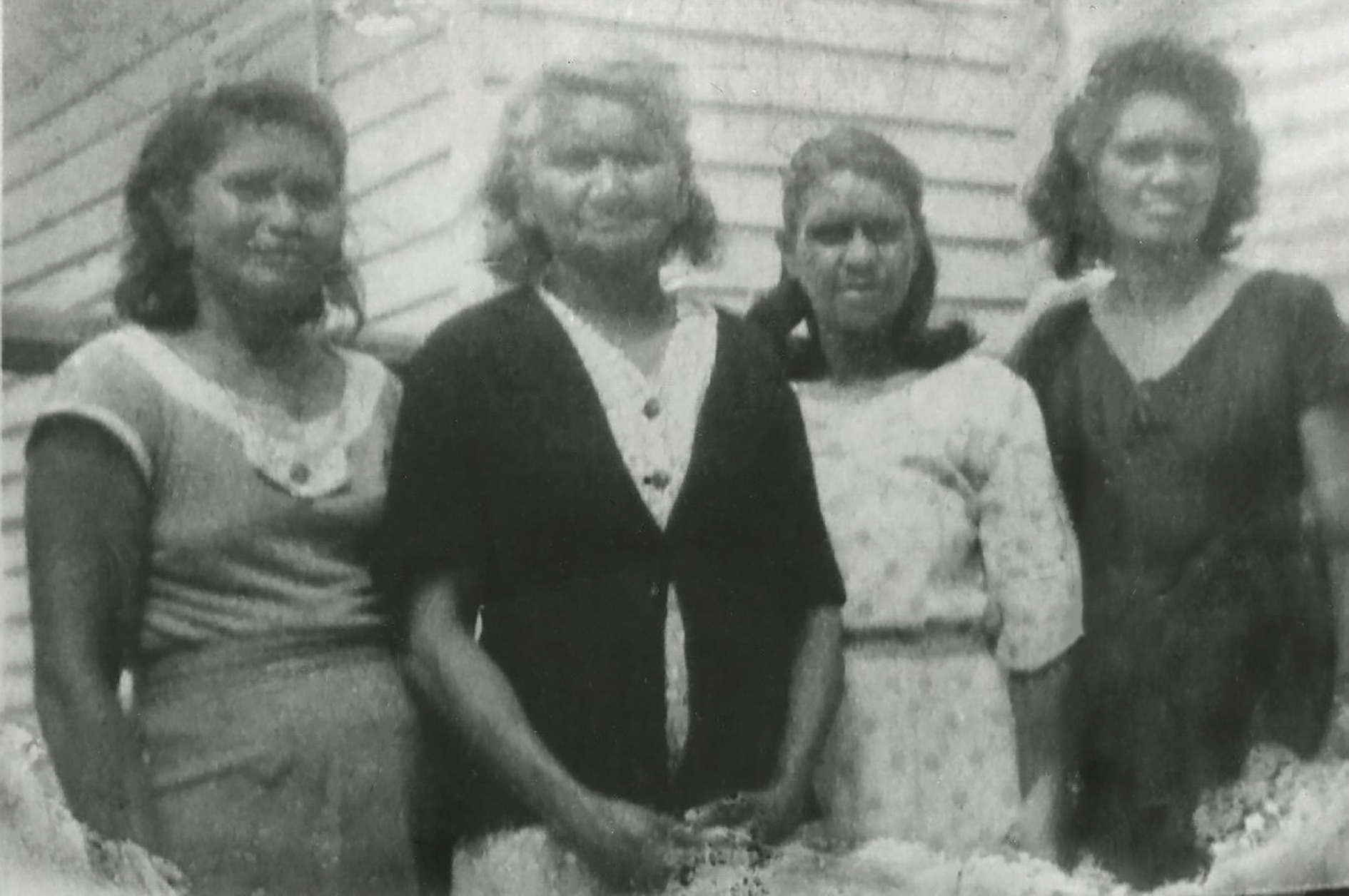
Granny Agnes Penny (center left) with three of her daughters: (L-R) Ayplin Eades, Mary Williams, Kate Riley at Gnowangerup. Image: courtesy of Eades family.
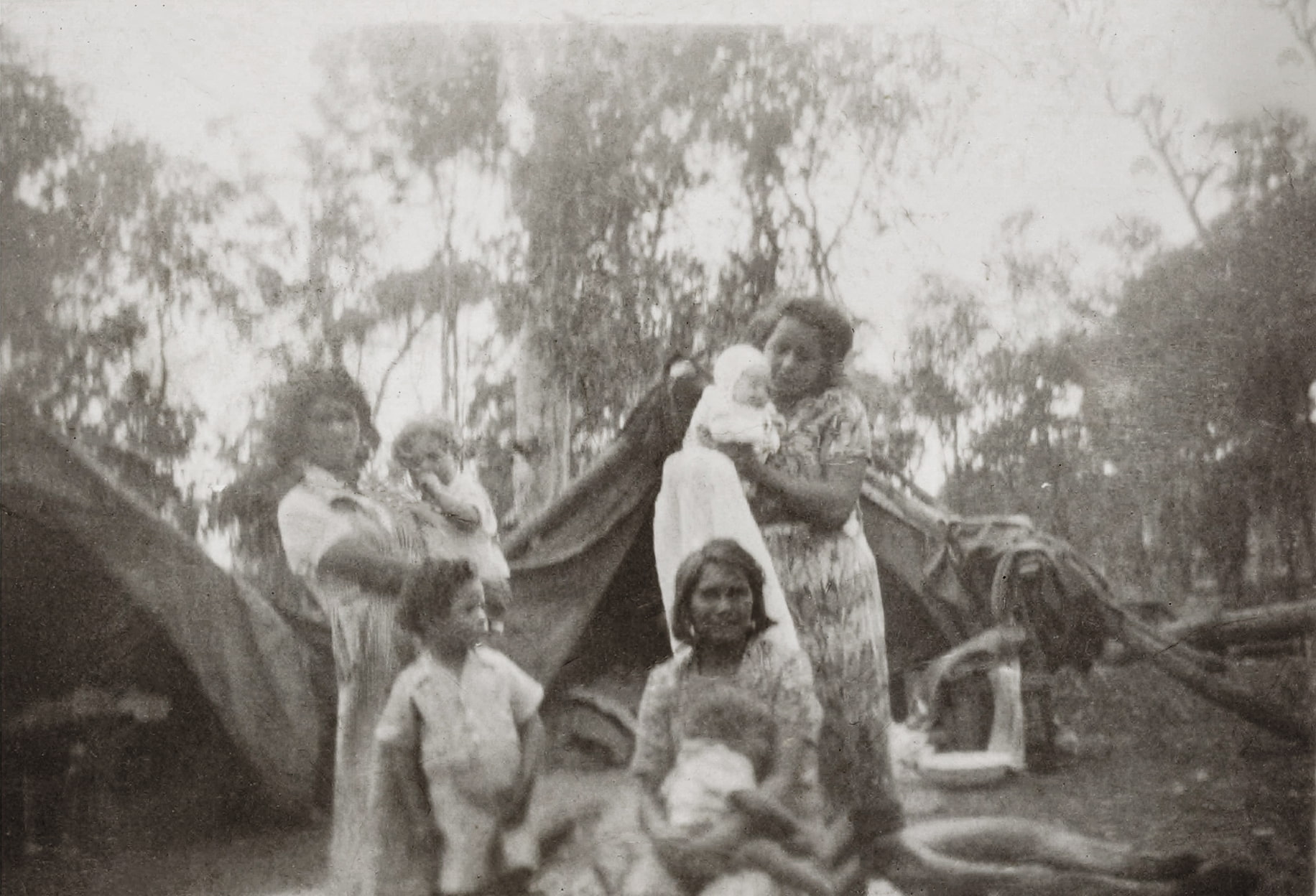
Mum Ayplin Eades (sitting), Violet Eades and Marion Eades at camp at Katanning. Image: courtesy of Eades family.

Pa Chris and Granny Ag were very family orientated. Their principles and values rubbed off on us — we always care for each other. Granny Ag was a real matriarch and she made sure we were looked after even through the toughest times. We went bush with her and learnt about bush tucker. She taught us the importance of culture.

We’ve been really privileged to have such people we can look up to with a lot of pride, love, and respect and who handed over the baton to us. Now we’re talking about handing the baton over to the next generation. Our yarn today comes back to people, because without people who are our teachers, we wouldn’t be able to do what we’re doing.

There’s so much we can talk about, but at the end of the day, I think it is about going back and respecting our cultural values, cultural practice, and what’s been instilled in us by our Elders.

We often have to work in a wadjella way and that’s important now because we live in a different era, a different time and place. But we hope our stories will keep going too, and that’s why I think it’s important for Aden and me to make some kind of contribution ‒ we’re the talkers of our experiences, we’re the knowledge sharers for our family. We respect other families’ experiences, but this yarn is from our Eades-Penny experience.

Aden: Kaarl (fire) was always part of our life. I was born in 1939 but didn’t live in a house until 1970. I was living in the bush on the reserve in Ongerup and had five kids by then. We had a good life in camps and the kaarl made sure we were alright. We had all the comforts thanks to the fire.
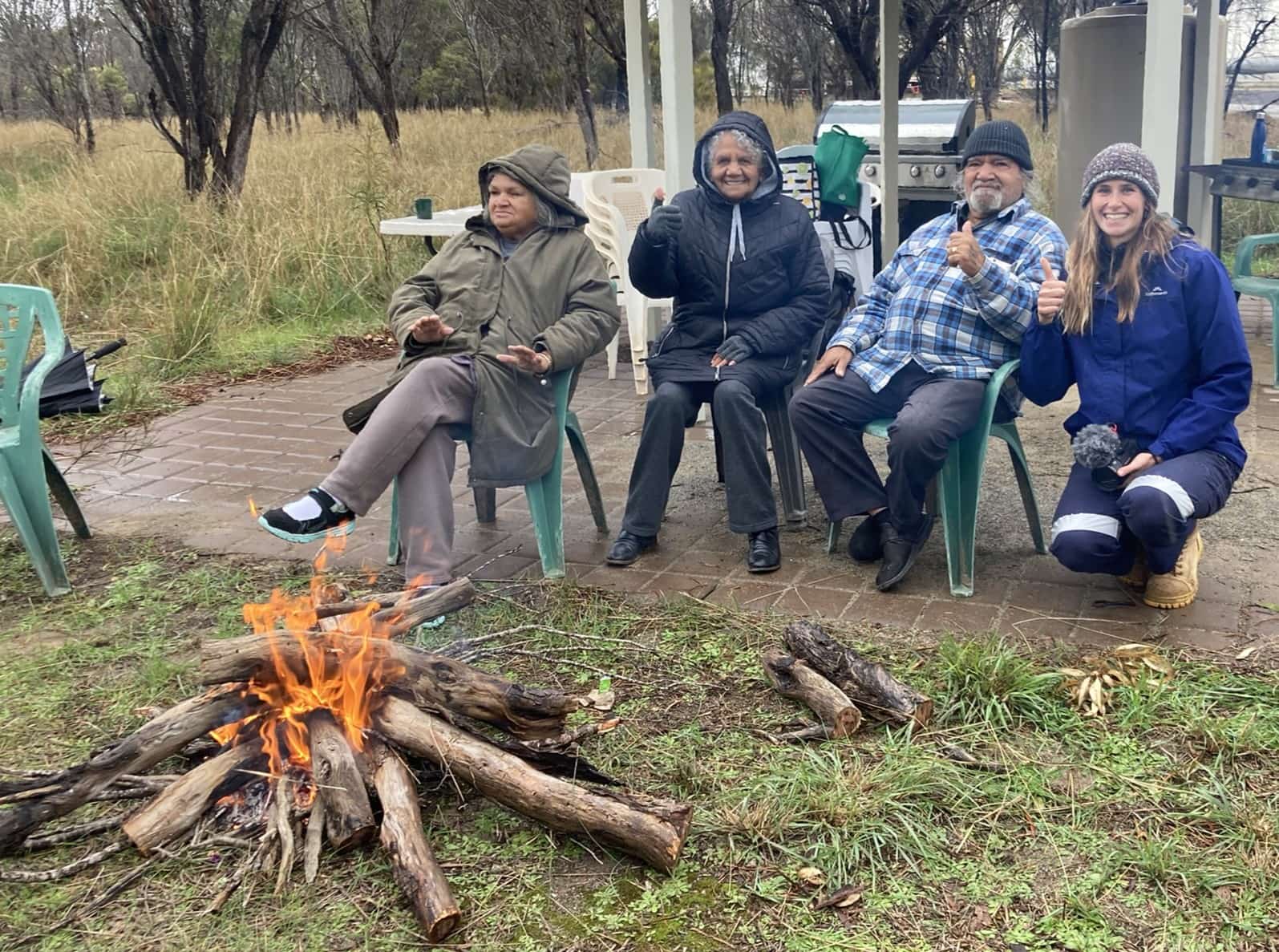
Eliza Woods, Annette Eades (cousin), Aden Eades and Ursula Rodrigues by a campfire at Borden Reserve, yarning about how to manage overgrown introduced species. Image: Alison Lullfitz.

When we were young, our family ‒ Grandfather Eades and his sons ‒ worked on farms during the land clearing years, burning up and cutting down and dealing with fire all the time. We learnt the cultural side of fire from a very young age from my other grandfather, Pa Chris Penny, and Grandmother Agnes. We didn’t mess around with fire; you don’t do that. That’s wiirnitch. That’s bad to do that.

As we grew, we were taught about patch burning. They’d burn up an area something like the small Elder-led burns we have been doing as part of our fire project, about 500 m2. They might do several patches and leave space between them, but they wouldn’t burn it all. They would light each patch and put it out. I remember they used to burn a fire break, instead of raking like we do today. Burning was mainly done for next year’s meat supply. The fire brought up new growth and fresh grass which yonga (kangaroo) and other animals liked to eat. The old people would come back to hunt in the burnt patch the following season.
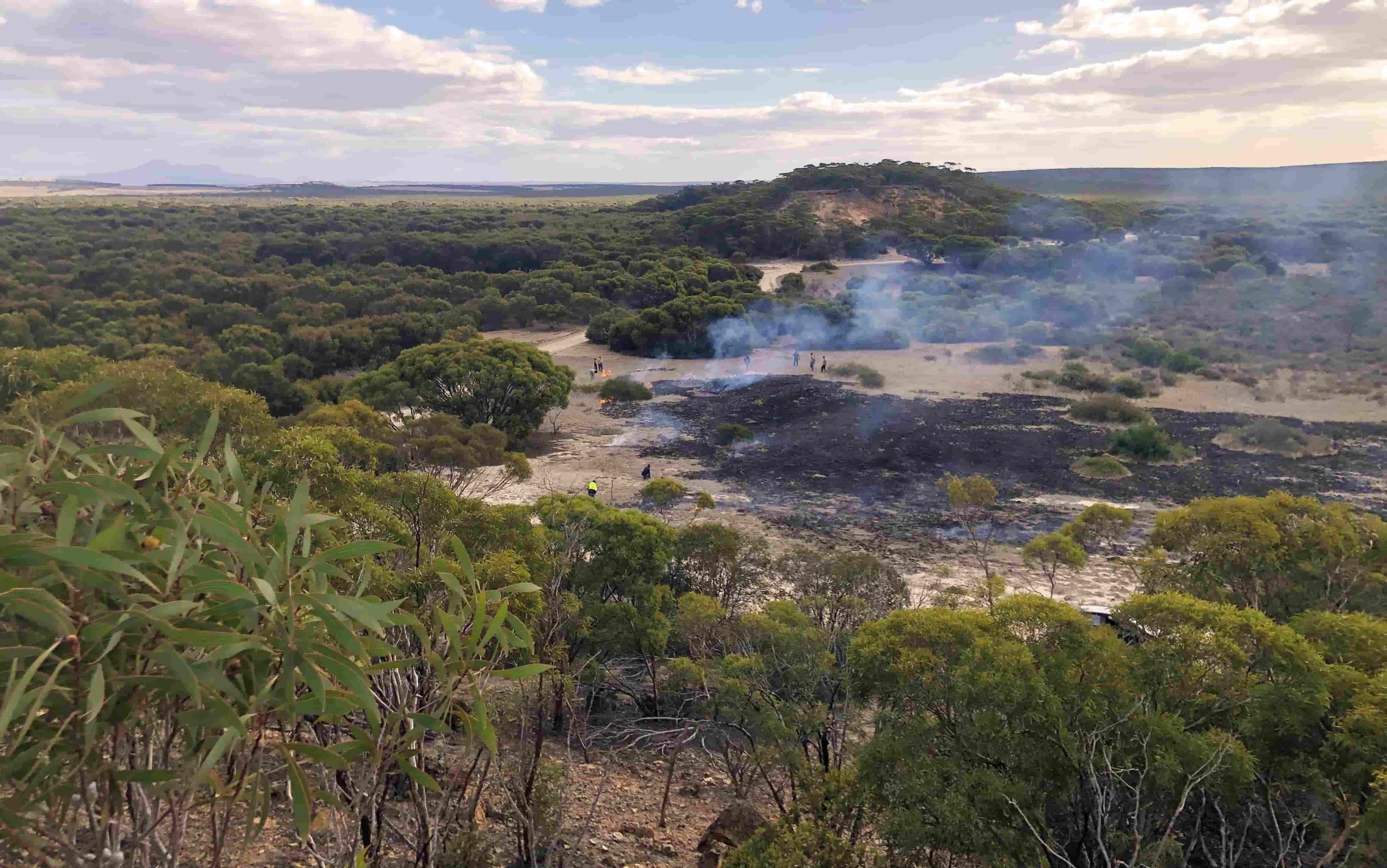
In May 2023, Goreng Elders led a burn in a cleared and salt-affected area at Nowanup near Boxwood Hill. This was the second season running that Elders and caretakers have regenerated Country and revitalized cultural knowledge through fire practice. Image: Ursula Rodrigues.

Eliza: We’d also burn for bushfoods, to encourage regrowth of all the bulbs and tubers, and our little runners with their fruit, like kurrup and kumuk (Billardiera spp.).

Aden spoke about his experience growing up with Grandfather Eades, but I always think about my experience of seeing fire. In mallee country, root picking and burning up were important when the farms were being cleared, but prior to that, fire was the centre of our camp life. It was our kitchen, our main place of gathering. The campfire was our classroom, that’s where we learnt about culture, the importance of fire, the bush, everything. We observed our parents and grandparents carrying on cultural practice around that fire and securing their bush camp by cleaning up the undergrowth and grass and sweeping it around. They took great pride in their camps.

Some younger Noongar people might think that this knowledge has gone but if we want to keep our culture and cultural practices, family values and beliefs, we need to continue it on and acknowledge that it is still there. These yarns identify who we are. Our language, our songs, our song lines, all connect to place. They’re all linked like a chain and it comes full circle back to the kaarl (fire).
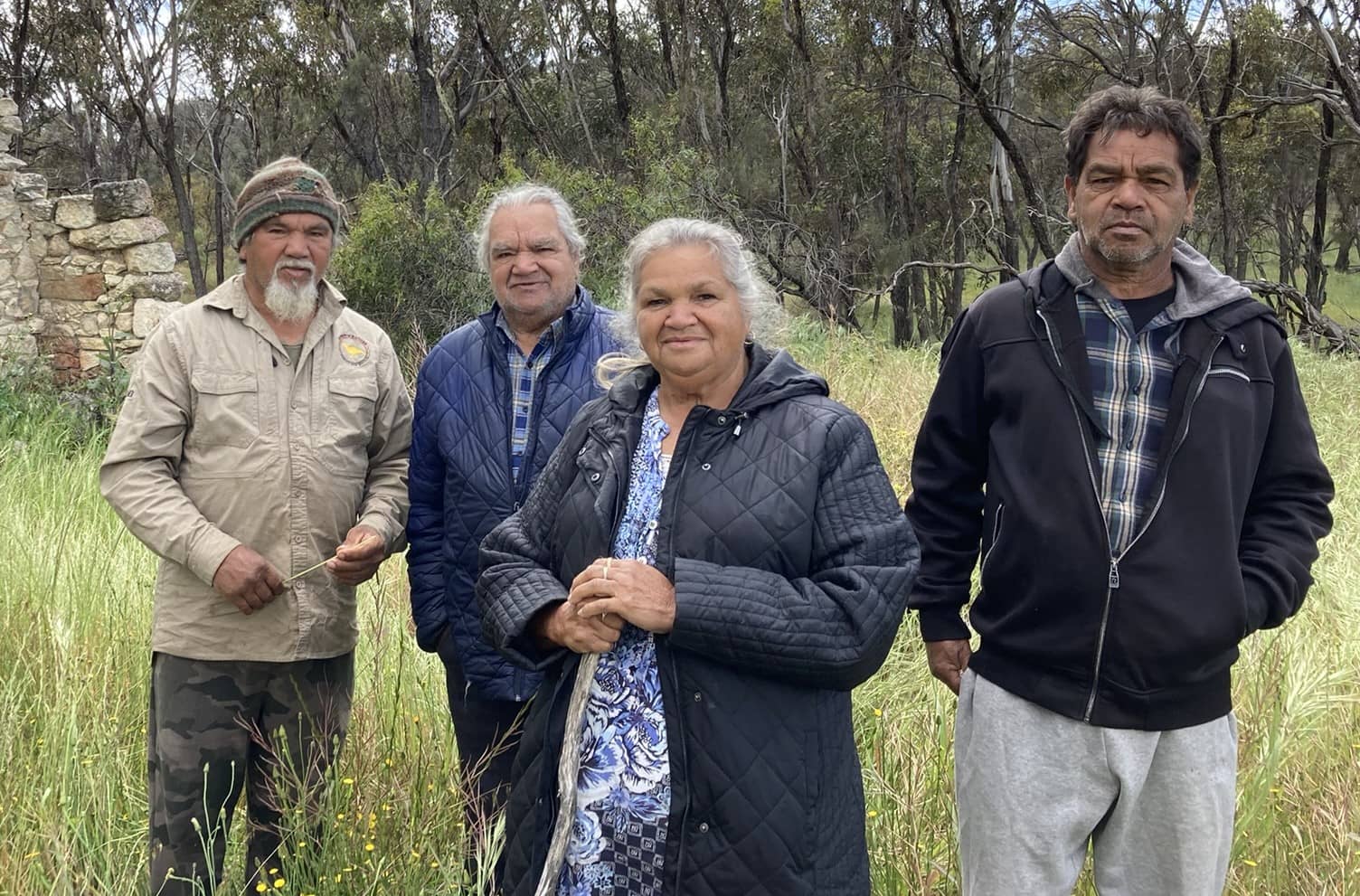
Eugene Eades, Aden Eades, Eliza Woods and Errol Eades (Aden’s son) (L-R) at Chimney Creek, Needilup, during a shared visit on Country to record family stories with researchers from UWA. Image: Alison Lullfitz.

Ursula: Through the time I have spent with the Elders on Country yarning about fire, they have taught me that there is no distinction between campfires, which are the social centre of life, and small controlled burns used to clean up and care for Country. The connection to fire through Noongar culture and spirituality is clear to me every time we are on Country together, like the warmth of sitting around a campfire with family and friends.

Country is the basis of life in Noongar culture. Permits and restrictions can prevent Noongar people from fulfilling their cultural obligations to access and care for Country.

Eliza and Aden: Now there are so many restrictions on fire. As Aboriginal people, we feel that we must ask permission all the time. As colonisation took over, we were either fenced in or fenced out, mostly fenced out. In our hearts, we feel like we shouldn’t have to ask permission to enter and care for our sites because we are connected to this country. Our grandparents and great grandparents walked and lived and hunted on these areas that we live in. So, there is always that question, why do we have to ask permission?

Our Elders knew all about the safety of fire. I don’t think in history a Noongar has ever let a fire get out of hand. We are aware that fire is danger and we’ve seen the damage done to properties and people’s lives by bushfires today.
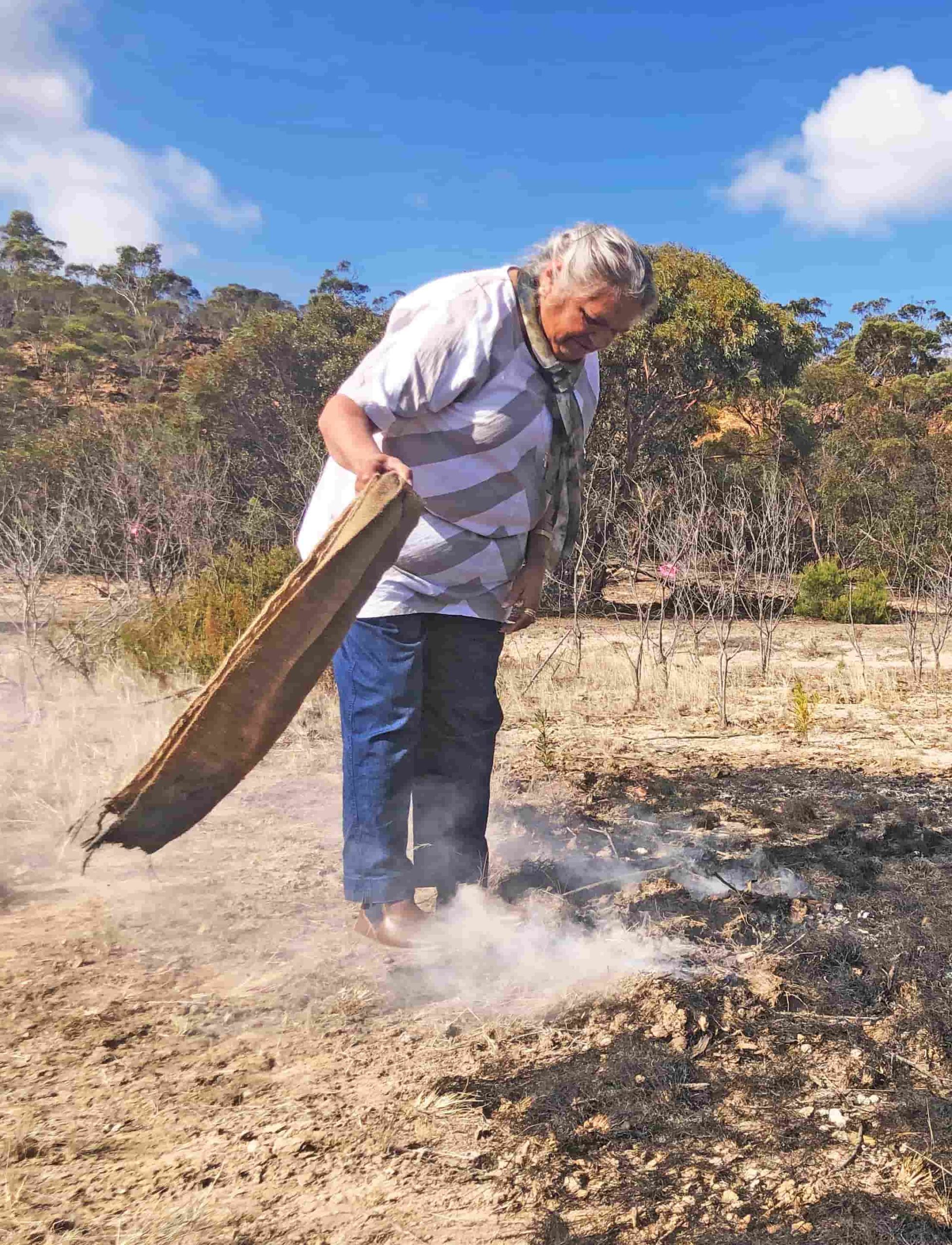
Aunty Eliza demonstrates how to use a wogga (wheat) bag to control small fires in grassland in the Fitz-Stirling area. Image: Ursula Rodrigues.

When we were young, our lives were very restricted and through discrimination we weren’t allowed to do a lot of things. Talking about fire permits takes me back to when Noongar people had to ask for a permit just to go into town. Even our old dad who was a returned soldier had to have a permit for that. Those kinds of things still have an impact on us. It impacts how Noongar people can accept or work with non-Aboriginal people. For me, non-Aboriginal people have got to win up that trust, first. Stand with us and look through our Noongar lens and see where we are coming from.

Wadjellas need to understand how important Boodja (land) is to Noongars. Noongars observed the Boodja. They’d see tracks from karda (goanna) or yourn (bobtail); or maybe a well-used yonga pad; or they’d see the hole in the ground where the old ninghan (echidna) went; or they might see possum scratches on a tree. Noongars always had six seasons. They knew what resources they could get when and where. For example, quandongs are only out during summer, so that’s when they’d go looking. Now we have weather like never before.
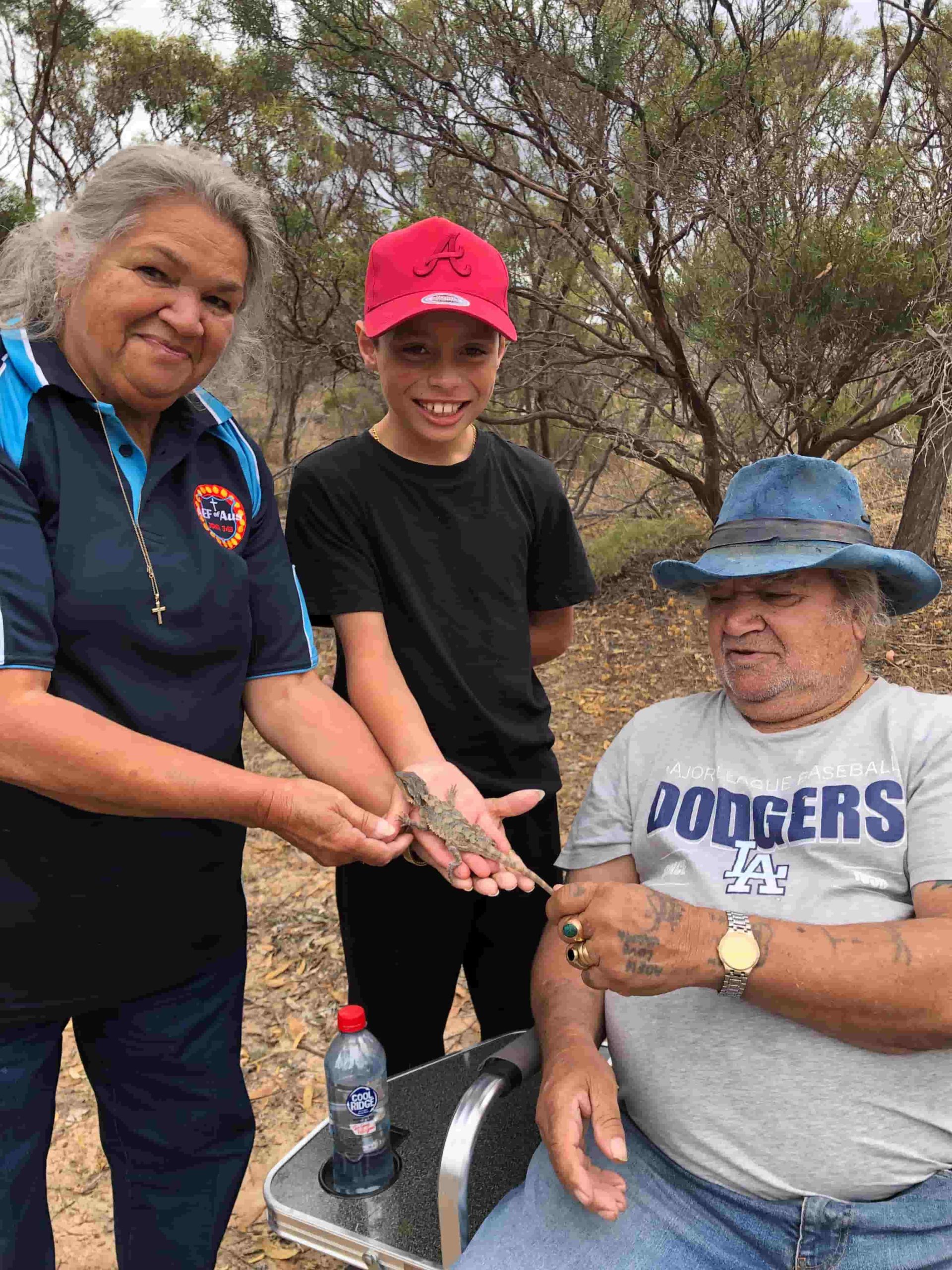
Aunty Eliza and Uncle Aden show Tyson, their grandson through Noongar kinship, a kullari (Pogona minor) during an eco-cultural visit to potential burn sites. Image: Ursula Rodrigues.

With burning today, Elders need to decide where it happens. We need to look at what plants and animals are in the area first. Once you know what’s growing there before a fire, you know what you’ve got to look for next year, and you can identify if there’s any new plants that come up after the burn. If the government or others are planning burns somewhere close to the old Native Reserves, or Country where Noongars lived, or a heritage site, it needs to be communicated with Elders. There could be a sacred place there or important food and medicine that could be damaged by a fire. In our burns, we protect life in general, but we need to see if there’s anything of significance there that needs special care. Now that we have been fenced out for a long time, we need to re-connect to knowing some places again.
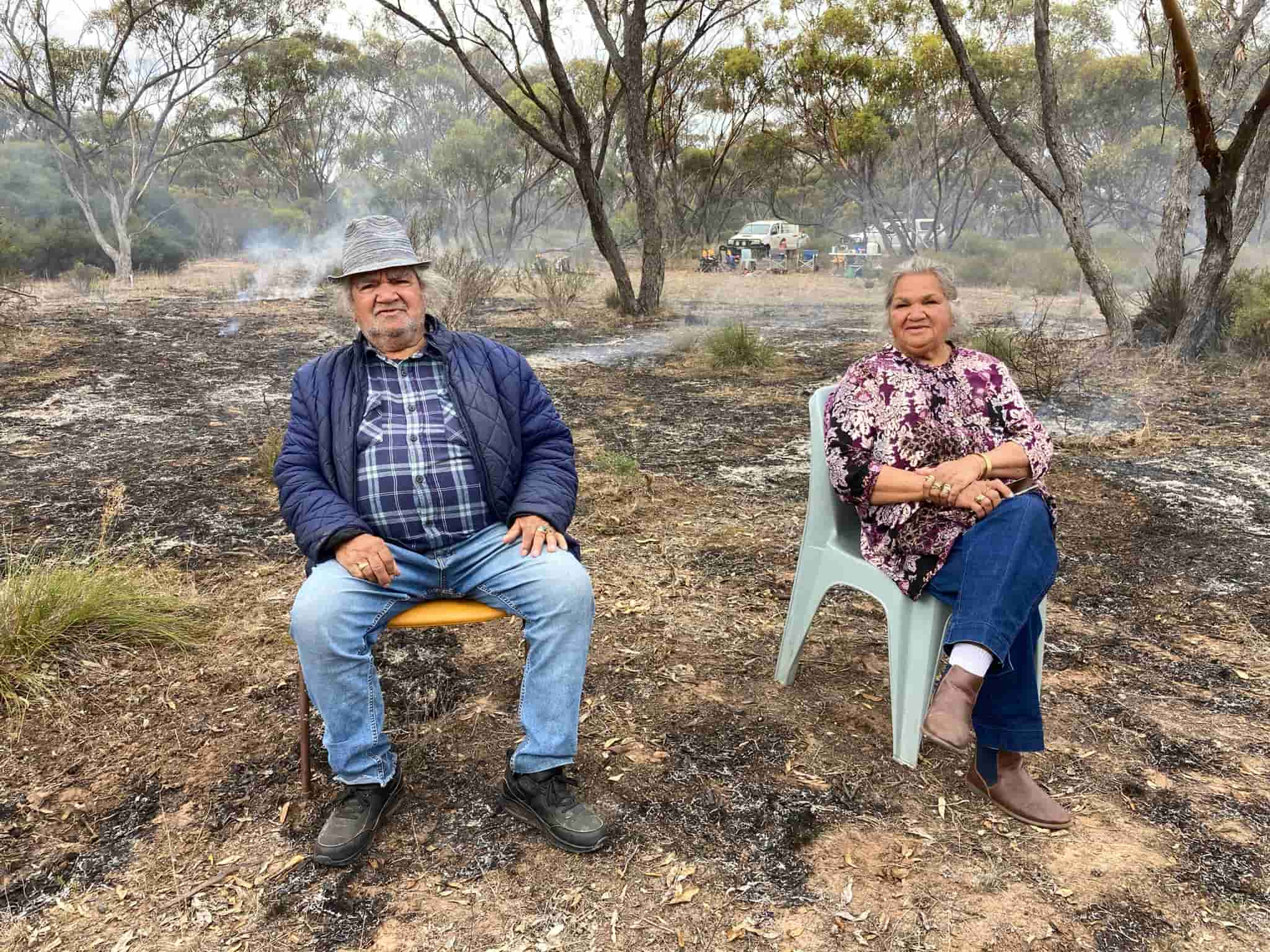
Elder-led caring for Country is important for the health of Country and people. Here, Uncle Aden and Aunty Eliza watch over and direct a patch burn in the Fitz-Stirling area. Image: Alison Lullfitz.

We also need to identify the different vegetation that’s going to be burnt, because that demonstrates the speed of fire, how it can travel. At a recent burn in a grassy area, it was quite windy, and the fire travelled very fast compared to our burn the day before under gum trees. But we had a bit of rain early that morning which helped because under the dry grass was damp, so the weather does play a part.

Noongars used to study the clouds and the wind to determine the right weather for burning — we still do that now. With technology we can use that to help us juggle and judge what day will be good.

Weather has to do with the safety of animals too. If you let a fire go and all the animals get boxed in and burnt, that’s no good. The very reason why we’re burning is to make sure the populations grow, for bush tucker, but also to look after animal and bird life and plants. We burn in the right season and control it to protect those things.  It’s not a big burn, it’s not a fast burn, it’s a slow burn, to let the animals escape.

As part of the collaborative project, Elders have been leading small fires on conservation properties in the Fitz-Stirling region to revitalise Country and fire practice.

Eliza: We recently did some burning in collaboration with wadjella organisations. Because we led the burns, we felt that we were in our own environment. We felt ownership and stronger connection to Country because we’re caring for it as we would care for a baby, nurturing it.

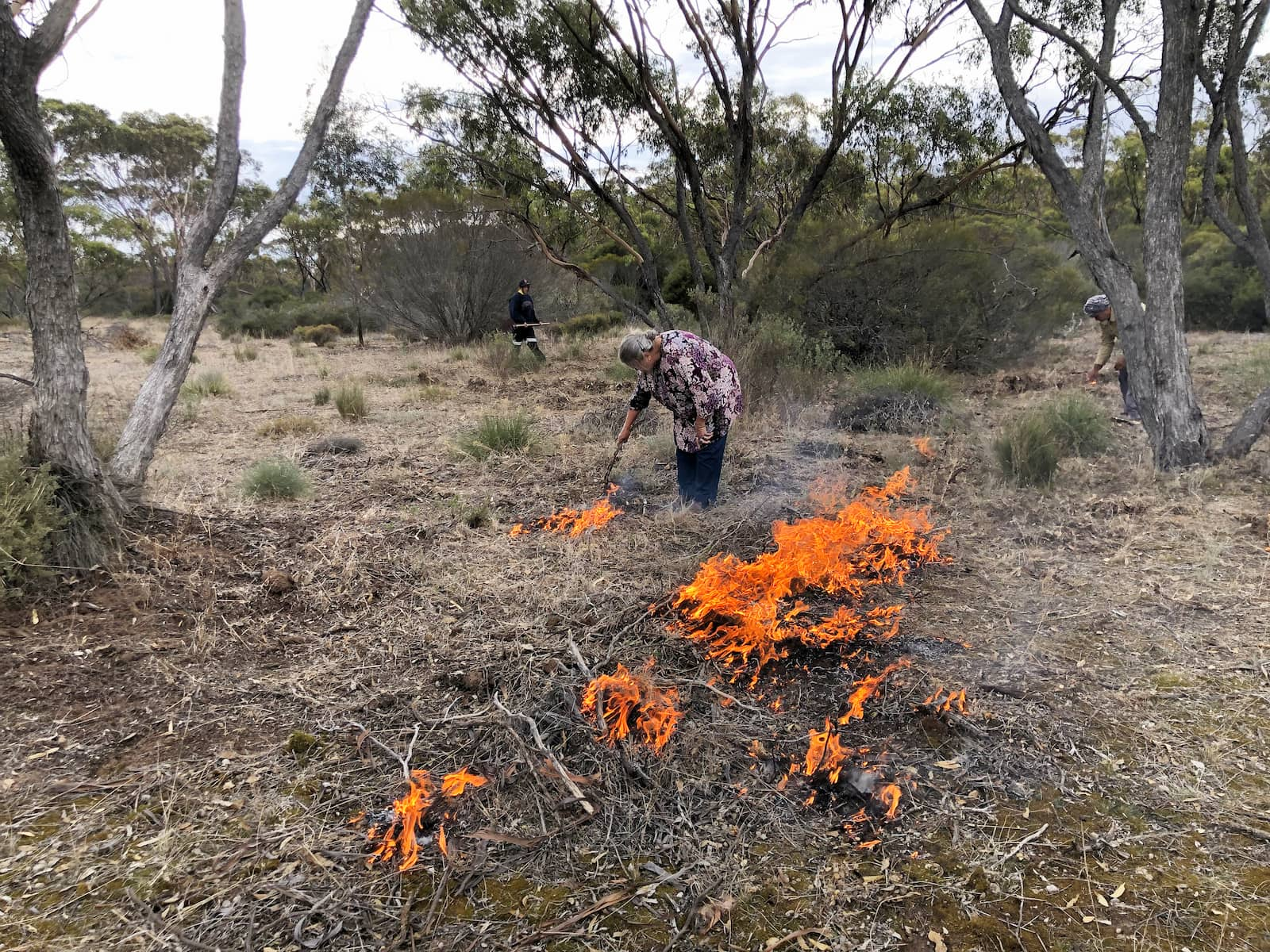
Aden and Eliza watch over and direct a burn in a cleared area at Bush Heritage’s Red Moort Reserve near Boxwood Hill. Image: Alison Lullfitz.

Aden: During these burns, I felt like I was living part of my old life when I was young, doing the same sorts of things from back in those days. When I get out in the bush, I’m right, I’m absolutely in my own environment.

Eliza: My observation was that all the wadjellas working with us showed a lot of respect. There was lots of communication and we were right in the action. I was so happy, true! The younger Noongar caretakers (rangers) also listened to us. We felt that our skills and knowledge were put into practice, and we saw it firsthand. That’s very rewarding and makes me feel like we are being valued.

Aden: Those fellas we had out there are professional people, full of knowledge about fire, and yet they just came right to our level. They were very respectful, and appreciative of our input. We were working together; they fitted right in ‒ it was just like all Noongars together.
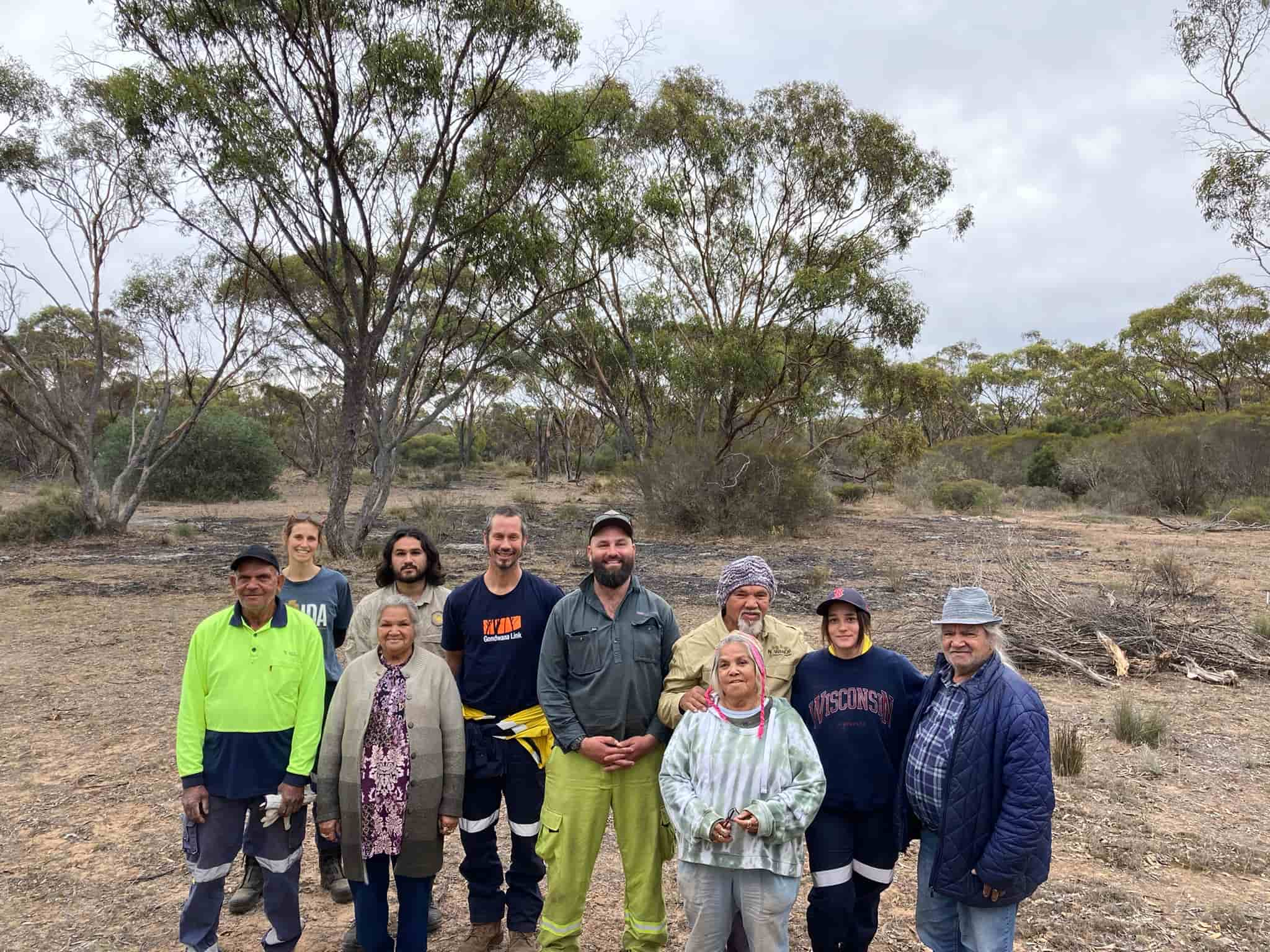
Our cross-cultural fire team on Boodja at Bush Heritage’s Red Moort Reserve after a successful day of Elder-led burning. (L-R) Tasman Hayward, Ursula Rodrigues, Eliza Woods, Robert Eades, Jim Underwood, Lewi Marr, Paulette Punch, Eugene Eades, Jessikah Woods and Aden Eades. Image: Alison Lullfitz.

Eliza: The burns were quite moving. It really does take you back. Even though the methods are a little bit different, the principles and the purpose behind it are the same. We don’t burn because we want to have fun or make smoke. There must be a purpose behind everything you do in the bush. We don’t just go out there so that someone can get a certificate saying they dealt with fire. It’s more than that.

There’s an emotion that comes in too. We’re excited that we’re able to do this now, but there’s sadness too because for our people back then, before big shops, the bush was their shop. And they got fenced in or fenced out and couldn’t go to a particular place where there was good hunting or good bush tucker. We’ve experienced that exclusion too, but now we are on the road to having a voice. Back then, they didn’t have a voice. So that’s where I think this project goes deeper than just fire. It’s about dealing with past hurts.

Uncle Aden, Aunty Eliza and Ursula are part of a team of Elders and researchers who have been working together on the ‘Walking Together’ project at UWA Albany for the last four years, recording Noongar family histories while learning about Country.

Eliza: We’ve been working alongside scientists to record the changes in Country after our burns. We are measuring the food and medicine plants that come back, as well as the weeds and other changes like the amount of dead leaves, twigs and branches. We’re working in partnership with Noongar and wadjella ways of looking after Country.  It is a two-way learning curve. Like recently at Nowanup, Ursula had these big measuring tapes, and I was thinking, “What’s this woman here doing? I’ve never seen that before.” So, it was a learning curve for us too, just like the students learn from what we share. If we’re going to work in partnership, there has to be Noongar and wadjella ways involved.

Ursula: It’s so rewarding to share ways of listening to Boodja (land) with Elders and to learn how our knowledges can work together for our common goal of caring for Country. I share my scientific knowledge and skills in quantifying and recording changes in the vegetation after a burn and the Elders share their ways of seeing the bush. There is always something to learn, mistakes to make, and usually I’m the laughingstock!
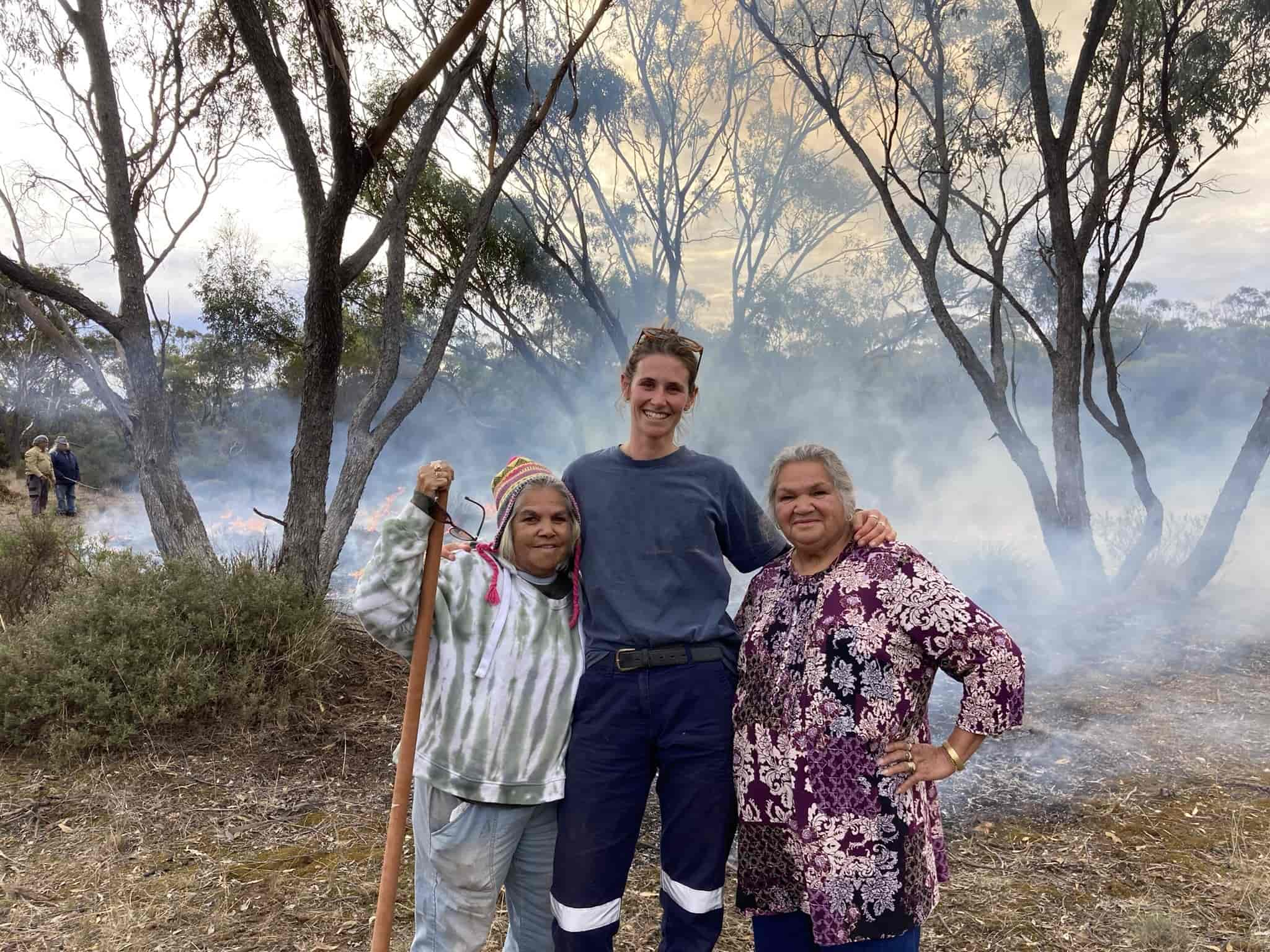
Paulette Punch, Ursula Rodrigues and Eliza Woods at an Elder-led burn in York Gum Woodland at Bush Heritage’s Red Moort Reserve near Boxwood Hill. Image: Alison Lullfitz.

Eliza: As I look back over the last couple of years that we’ve been working together, I feel that I have been so blessed to be able to share some of my life’s journey, family history and stories of places and people, and to learn some new knowledge about connections our family has in the Great Southern.

Aden: The knowledge has been lying dormant. When we revisit places where we grew up, it’s like turning a page in a book and seeing scenes from our childhood. But now, when we reflect on those memories, we’ve got the freedom to reconnect to the knowledge that our Elders gave us.

Eliza: We’ve got the opportunity now with technology to record our stories. It’s more than just research to us. We’re not going to end up with a Doctorate, but we’ve already got that because we were born with our knowledge and our culture. We get to record our stories and comments; that’s going to be there for a lifetime, for our children and grannies. I feel safe that our things are in good hands.

Aden: Some of the researchers have become like family. I’ve enjoyed the time I’ve been involved with the university, and I always look forward to the next trip. We have a bit of fun along the way, a few laughs, but that’s how friendship goes. It’s more than friendship, they feel like family.

Eliza: Spending time on Country is so important. It gives us time out from our daily routine. Everything’s left in town, and we can recharge our physical batteries. It is so nice to sit around and yarn with other Elders and families. On a recent trip, we sat around the fire, having damper as if we were home, having the best time.  
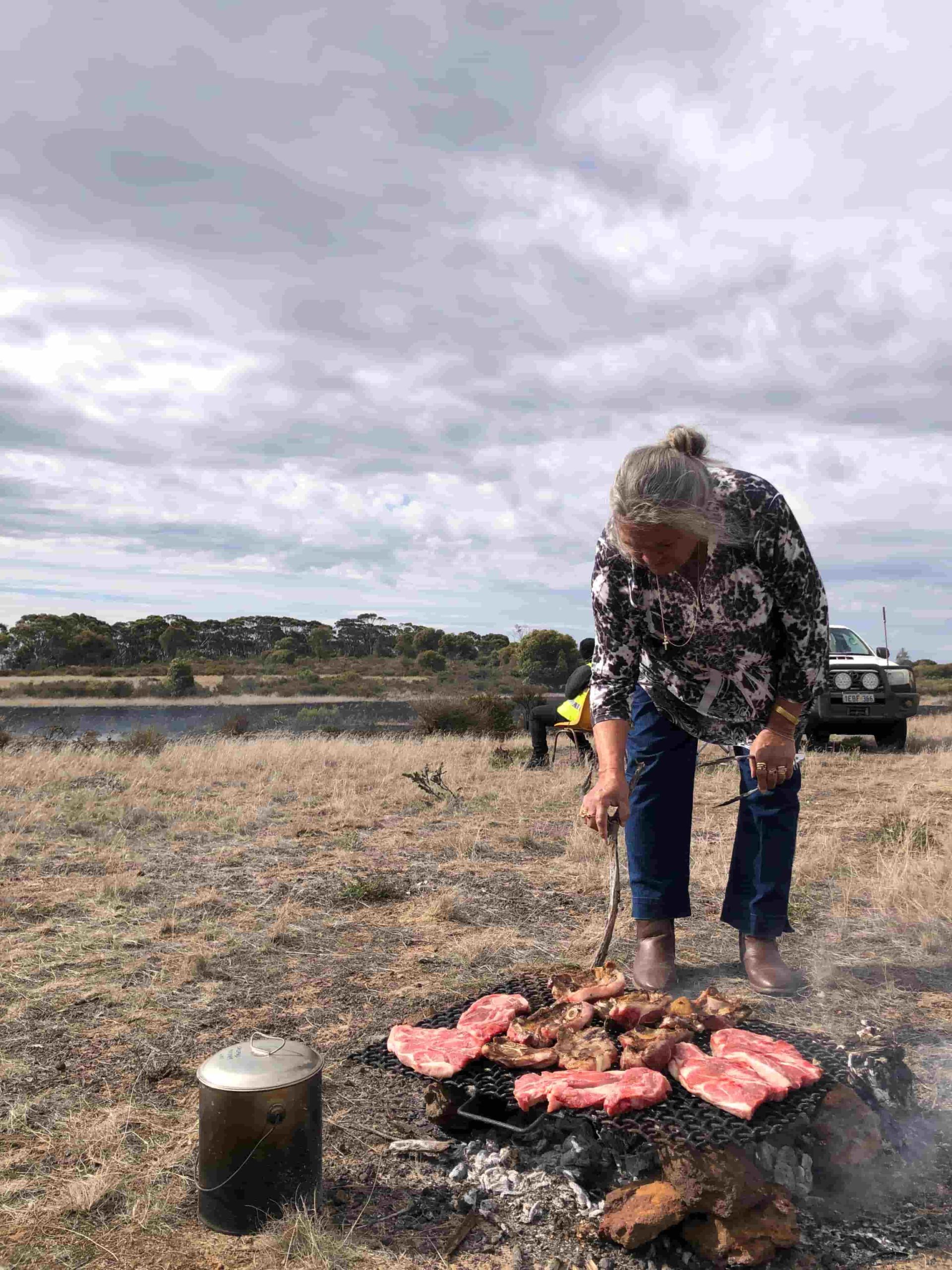
Aunty Eliza cooks on the campfire at the end of a day of patch burning at Bush Heritage’s Red Moort Reserve. Image: Ursula Rodrigues.

Ursula: Working together means establishing reciprocal relationships. As researchers we have obligations to Noongar colleagues to look after the knowledge entrusted to us and to do our best to answer our shared questions with the skills we have. We also have obligations to work more broadly towards institutions, communities and towns that are more embracing of everybody.

Eliza: Wadjellas have been a part of our lives for over 200 years. If we work side by side with them, in any field, it must be a two-way relationship. It must come from a place of respect for each other and for what’s happened up to today. We can’t change the past, but we can make the future better by communication. Our purpose is to record and create knowledge that will be helpful for our Noongar kids, for wadjellas, for everyone, to create a better future for all people and for Country. Yarning about kaarl, fire, is a really powerful way to do that.

THANKS to Aden Eades, Eliza Woods and Ursula Rodrigues; the photographers; Alison Lullfitz, Marg Robertson and Keith Bradby for editorial input; and Carol Duncan for photo editing and webpage development. Thanks also to Uncle Eugene Eades, Stephen Hopper and Bush Heritage Australia.

Special thanks to all Noongar collaborators and families involved in our cultural fire project. This project acknowledges the funding contribution of the Commonwealth Government and support from the WA State Emergency Management Committee. This work is a collaboration with UWA Albany Walking Together Project, funded by South Coast Natural Resource Management and supported by Lotterywest.


This story is also available online in the November 2023 edition of the Southerly Magazine.

FURTHER READING

Aunty Eliza uses porrong bush to spread flames along the ground at an Elder-led burn in York Gum Woodland. Image: Ursula Rodrigues.