


Overview
Step into the sculpture and find your place within the Tree of Life…
This striking sculpture is part of the Gondwana Link Genestreaming Sculpture Trail that links Northcliffe and Ravensthorpe.

The creative concept of Menang Elder Aunty Carol Pettersen and lead artist Ben Beeton, the Genestreaming project is an innovative collaboration between First Nations and non-Indigenous artists and conservation groups.
Each sculpture celebrates the evolutionary processes behind southwestern Australia’s incredible biodiversity, uniting traditional Noongar knowledge with Western science.
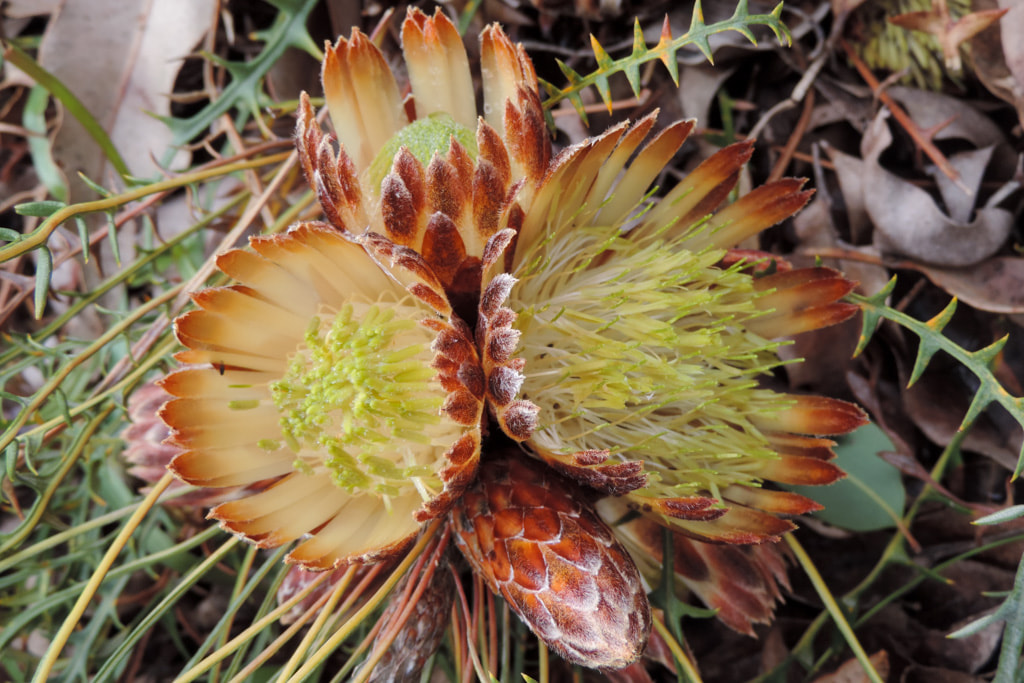
Dryandra ferruginea subsp ferruginea (syn Banksia rufa)
Image: Kevin Collins
All of the sculptures have the same form, inspired by the bracts (or petals) of local dryandra and banksia flowers.
The outside petals feature the artworks of Noongar artists, depicting connections to Country through stories of plants and animals.

The inside of the petals trace the evolution of 15 distinctive plant and animal species from the region, over hundreds of millions of years.

A team of local artists, craftspeople and community organisations were involved in bringing the sculpture into being.
Story of the place
Noongar Boodja
Listen to Carol Pettersen describe the significance of this sculpture and the broader project:
Aunty Carol Pettersen hopes the sculptures will form a national tourism trail to increase awareness of the importance of ecological restoration, cultural restoration, and art. And also increased awareness of how, through deep time, all species are connected within the Tree of Life.
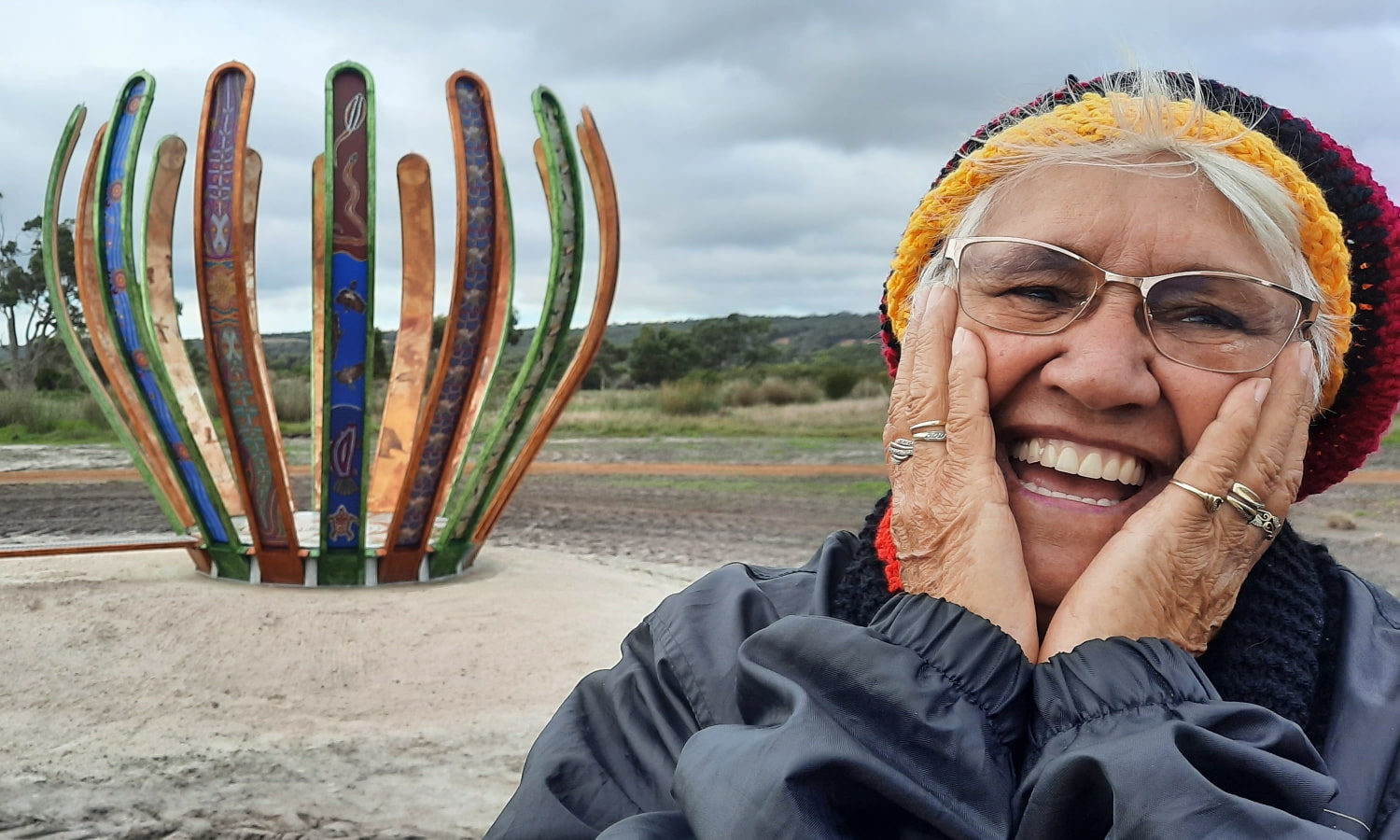
Menang Elder Carol Pettersen at the launch of the first Gondwana Link Genestreaming sculpture at Twin Creeks Reserve in the Porongurups
Image: Ben Beeton
Geological time

Image: Ben Beeton
The geological timeline depicted in the sculpture baseplate begins with the ‘Cambrian explosion’ which occurred roughly 541 to 530 million years ago. This period was marked by the unparalleled emergence of organisms including many of the major phyla that make up modern animal life.
A remarkable amount of evolutionary development has happened since then. Vascular life has been evolving continuously in southwest Australia for about half the time that vascular life has been evolving on earth.
But it is worth noting that this is just a portion of the entire spectrum of geological time on earth, which started some 4.5 billion years ago. For a local comparison – the Porongurup Range is estimated to have been formed 1.2 billion years ago.
Read the Ancient Wonderland story for a more detailed dive into how this ancient history has created such a unique ecosystem.
The Artists
Aunty Carol Pettersen, local Menang Noongar Elder, invited Noongar artists from the Great Southern to participate in creating artworks for the outside of the sculpture. The artists featured at Denmark:
Donna Coyne
Tommy Dimer
Cameron Gravestock
Robert Swift
Brianna Williams
Glenda Williams
Narelle Williams


A compilation of each of the panels from the sculpture
Image: Ben Beeton
For the inside of the sculpture, field naturalist studies of the 15 selected species were created by scientific illustrator Mali Moir and Ben Beeton.
Further illustrations were provided by Jane Thompson, Katrina Syme and Alastair Robinson. Photography by John Anderson. Eco-dyeing by Jenny Wilson.
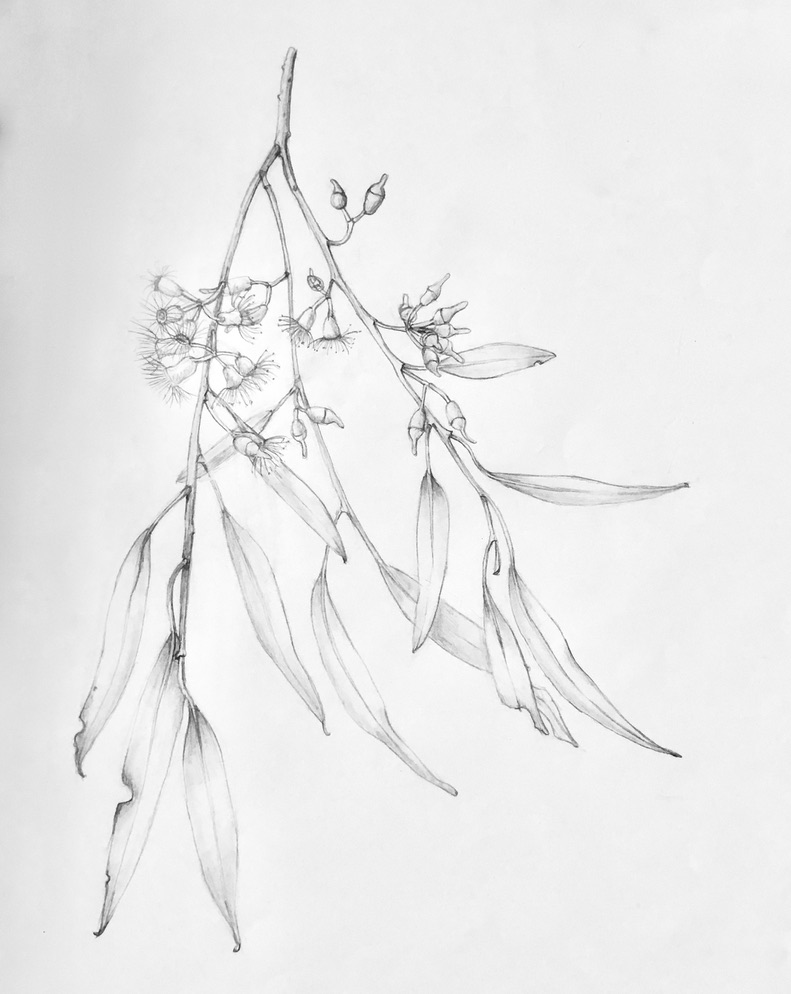
Eucalpytus flocktoniae
Image: Jane Thompson
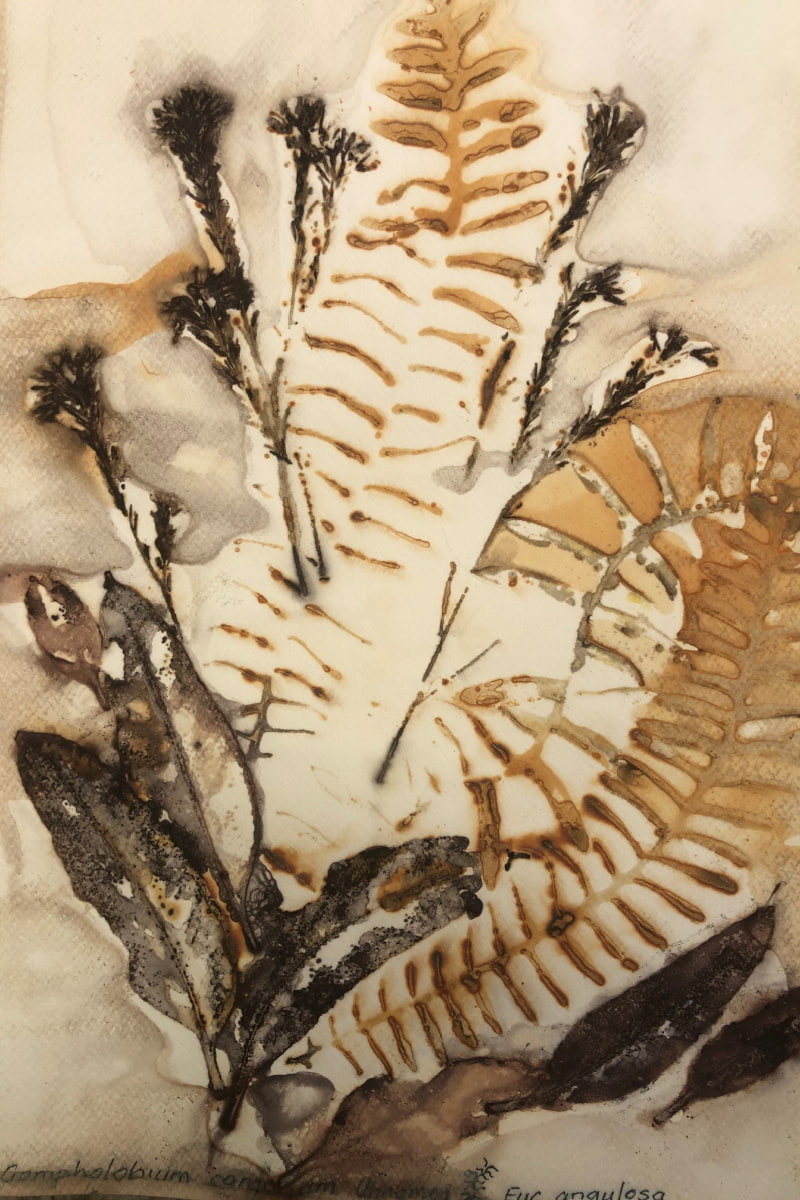
Natural dye impressions of local plants
Image: Jenny Wilson
The sculpture was designed by Ben Beeton following his work at the Australian National University on using virtual reality to visualise ecosystems through deep time. The sculpture was crafted by local artist Mark Hewson.
Research for the common ancestry of selected regional species was undertaken by Gary Muir of WoW Wilderness Tours and Ben Beeton.
The science behind the sculpture
Ben Beeton describes how the base plate of the sculpture represents the deep-time history of the evolution of these animal and plant species. He says: When you enter this model, you are entering as a representative of the human species, in this special evolutionary tree.

Aerial view of the baseplate with lead artist Ben Beeton and supporters at the launch of the Denmark sculpture
Image: SciArt
Celebrating the diversity
In Denmark seven animals were chosen:
Quenda / Southwestern Brown Bandicoot – Isoodon fusciventer
Djorrdjilya / Splendid fairywren – Malurus splendens
Ngoowak / Blue Banded Bee – Amegilla cingulate
Norryn / Tiger Snake – Notechis scutatus
Sunset Frog – Spicospina flammocaerulea
King George Whiting – Sillaginodes punctatus
Mains Assassin’s Spider – Zephyrarchaea mainae

Quenda

Splendid fairy wren

Sunset frog

Blue-banded bee
Six plant species:
Boorn / Red-flowering gum – Corymbia ficifolia
Karri / Karri – Eucalyptus diversicolor
Dingul dingul – Yellow Tingle – Eucalyptus guilfoylei
Albany Pitcher Plant – Cephalotus follicularis
Wonnich / Native Willow – Callistachys lanceolata
Yorral / Swamp Paperbark – Melaleuca preissiana

Red-flowering gum

Albany pitcher plant

Swamp paperbark

Dingul dingul
Two fungi species:
Ghost fungus – Omphalotus nidiformis
Beef-steak fungus – Fistulina spiculifera

Beefsteak fungus
More stories
Dive deeper into stories of people and place.


See & Do
Get up close with the sculpture

Admire the Noongar artworks on the outside of the sculpture and contemplate the cultural connections to country, and stories of significant plants and wildlife from the region.
Look out for: xxxxxx
Walk into the middle of the sculpture and immerse yourself in the deep time story of the evolution of fifteen different local species through detailed illustrations on the petals of the sculpture.
The baseplate of the sculpture depicts a phylogenetic tree of each species’ evolution ‒ a visual illustration of shared ancestry of all species in the planetary Tree of Life, over the span of the geological timescale.
From the detailed drawings on each petal of a single species you can follow that down to the baseplate, and trace its evolutionary path through geological time and shared ancestry, back to the common ancestor of all life on Earth.

Get Involved


Nearby
There are many other sites to visit nearby including:
Practical Information
Directions
Kwoorabup Community Park is on Research Station Avenue, off Horsley Road.
Facilities
The sculpture is located at the Kwoorabup Community Adventure Park, which is close to the centre of Denmark, next to the river and the Denmark Hospital. Facilities include:
- Nature-based playground
- The Kwoorabup Walk Trail next to the river which has been revegetated over the past few decades
- Barbecue facilities
- Public toilets
Visitor Information
